Japanese Knife Glossary: Terms, Kanji and Meanings
Takumi Path is reader-supported. Some links on this page are affiliate links: if you buy or book through them, we may earn a commission at no extra cost to you. Learn more.
Key points
- Each entry gives the English term, the Japanese spelling, a romanized reading and a short meaning, checked against Japanese sources.
- Many knife names describe a job or a shape, and some, such as yanagiba and takohiki, are regional variants of the same knife rather than different grades.
- Steel names such as shirogami, aogami and VG10 tell you the raw material, not where the knife was made.
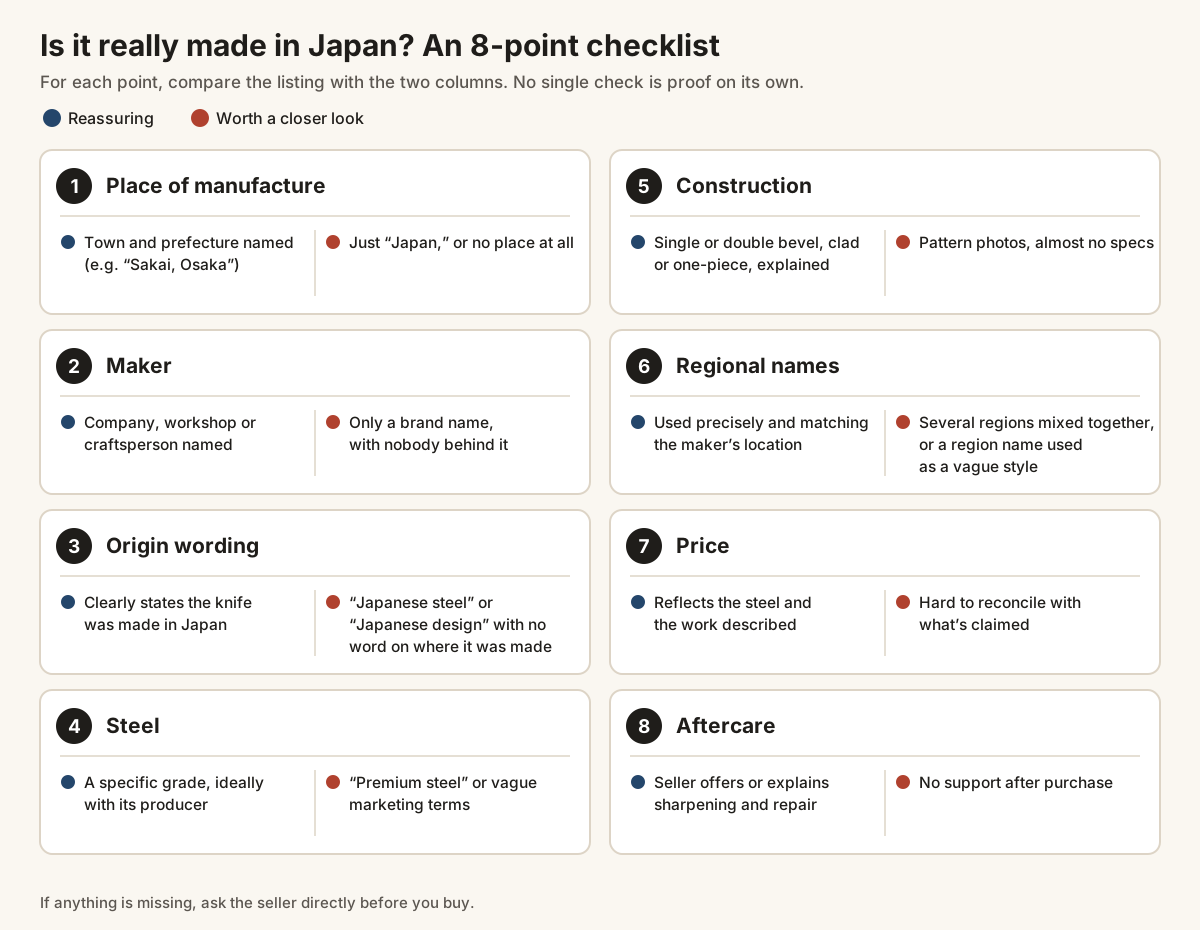
- Names such as Sakai Uchihamono and Seki no Hamono are official designations or registered trademarks, so a label that carries one can be checked; a good knife without a label is not automatically suspect.
- Where Japanese sources spell a term in more than one way, we follow the source or leave the kanji out.
Contents
- Start here
- A–Z index
- Traditional knife types (wa-bocho)
- Western-style and all-purpose knives (yo-bocho)
- Edge, bevel and shape
- Steel and construction
- Forging and craft roles
- Care and sharpening
- Places, shops and makers
- Towns and regions
- Shops, museums, workshops and makers
- Labels, certification and history
- Summary
You are standing at a knife shop counter, or scrolling a product page, and the description is full of words you can’t read: a blade stamped 白紙, a label that says Sakai Uchihamono (堺打刃物), a line about kataba (片刃) edges. English listings often translate these loosely, or not at all.
This glossary is for looking things up. Find a word in the A–Z index, or open the group that fits your question. Each entry gives the Japanese spelling, a romanized reading and a short meaning from Japanese makers, producers’ associations and public bodies. Readings use simple romanization without long-vowel marks (gyuto, not gyūtō); a dash means no reading is given. Your browser’s page search also works on kanji, such as 白紙.
Start here
If you only learn ten terms, make them these. They come up again and again on product pages.
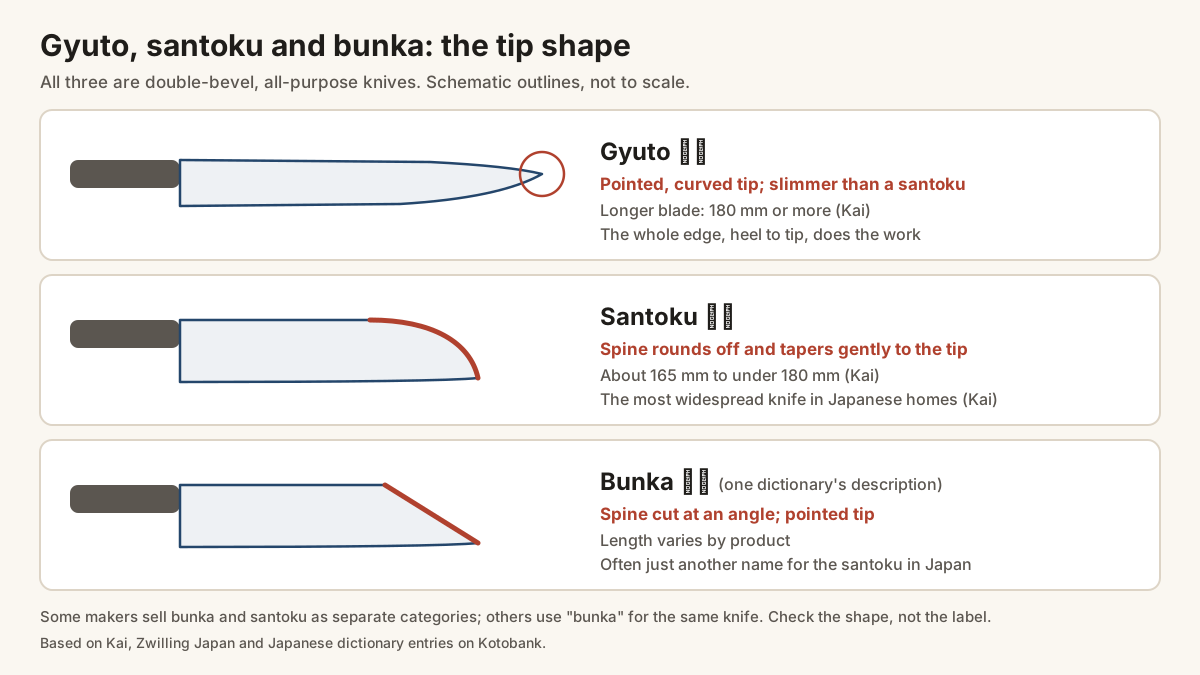
- Gyuto: a double-edged, all-purpose knife with a pointed tip, 180 mm or longer. Western-style knives
- Santoku: a double-edged, all-purpose knife, about 165 mm to under 180 mm. Western-style knives
- Kataba: single-edged; the cutting bevel is on one face only. Edge and shape
- Ryoba: double-edged; ground at roughly the same angle on both faces. Edge and shape
- Shirogami: “white paper” carbon steel from Proterial. Steel
- Aogami: “blue paper” steel, shirogami with chromium and tungsten added. Steel
- VG10: a stainless knife steel developed by Takefu Special Steel in Echizen. Steel
- Honyaki: a knife made entirely from one piece of steel. Steel
- Damascus: layers of different metals on the blade sides that show a pattern when ground. Steel
- Sakai Uchihamono: Sakai’s forged blades, a Traditional Craft and a regional collective trademark. Labels
A–Z index
Each term is followed by the group whose table lists it. The group names below link to the full headings.
| Label | Group |
|---|---|
| Traditional types | Traditional knife types (wa-bocho) |
| Western-style | Western-style and all-purpose knives (yo-bocho) |
| Edge and shape | Edge, bevel and shape |
| Steel | Steel and construction |
| Forging | Forging and craft roles |
| Care | Care and sharpening |
| Towns | Towns and regions |
| Shops | Shops, museums, workshops and makers |
| Labels | Labels, certification and history |
| Terms | |
|---|---|
| A | Aigami (Steel) · Aogami (Steel) · Aratoishi (Care) · Awase (Steel) · Azumagata (Edge and shape) |
| B | Ban (Care) · Bo-toishi (Care) · Bunka bocho (Western-style) |
| C | Chiiki dantai shohyo (Labels) |
| D | Damascus (Steel) · Deba (Traditional types) · Deba-ya (Forging) · Dento mark (Labels) · Dento shoshi (Labels) · Dentoteki kogeihin (Labels) |
| E | Echigo Sanjo Uchihamono (Labels) · Echizen (Towns) · Echizen Uchihamono (Labels) · Etsuke (Forging) |
| F | Funayuki (Traditional types) |
| G | Gensankoku (Labels) · Gifu Seki Hamono Kaikan (Shops) · Gingami (Steel) · Gyuto (Western-style) |
| H | Hagane (Steel) · Hagane-tsuke (Forging) · Hamo honekiri (Traditional types) · Hamon (Steel) · Hatsuke (Forging) · Hizukuri (Forging) · Honesuki (Western-style) · Honyaki (Steel) |
| J | Jigane (Steel) · Jiyu tanzo (Forging) |
| K | Kai (Shops) · Kakugata (Edge and shape) · Kamagata (Edge and shape) · Kansai (Towns) · Kanto (Towns) · Kappabashi Dogu Street (Towns) · Kasumi (Steel) · Kataba (Edge and shape) · Kido (Steel) · Kiritsuke (Traditional types) · Kiya (Shops) |
| M | Manaita (Care) · Mawashi-hagane-tsuke (Forging) · Men-bocho (Traditional types) · Mino-den (Forging) · Mioroshi (Traditional types) · Moroha-ya (Forging) |
| N | Nakatoishi (Care) · Nakiri (Traditional types) · Nimai-hiroge (Forging) · Nishigata (Edge and shape) |
| P | Petty (Western-style) · Proterial (Shops) |
| R | Ryoba (Edge and shape) |
| S | Sakai (Towns) · Sakai Denshokan (Shops) · Sakai Hamono (Labels) · Sakai-kiwame (Labels) · Sakai Uchihamono (Labels) · Sanjo (Towns) · Sanjo Kaji Dojo (Shops) · Santoku (Western-style) · Seki (Towns) · Seki Kaji Denshokan (Shops) · Seki no Hamono (Labels) · SG2 (Steel) · Shiagetoishi (Care) · Shirogami (Steel) |
| T | Tabako-bocho (Labels) · Takefu Knife Village (Shops) · Takefu Special Steel (Shops) · Takohiki (Traditional types) · Tansetsu (Forging) · Tanzo (Forging) · Three-layer clad steel (Steel) · Toginaoshi (Care) · Toishi (Care) · Tosa (Towns) · Tosa Uchihamono (Labels) · Tsuchioki (Forging) · Tsukiji Aritsugu (Shops) |
| U | Uchihamono (Forging) · Unagi-saki (Traditional types) · Ura (Edge and shape) · Usuba (Traditional types) · Usuba-ya (Forging) |
| V | VG10 (Steel) |
| W | Wa-bocho (Traditional types) · Warikomi (Steel) |
| Y | Yakiire (Forging) · Yakimodoshi (Forging) · Yanagiba (Traditional types) · Yasugi (Towns) · Yo-bocho (Western-style) |
Traditional knife types (wa-bocho)
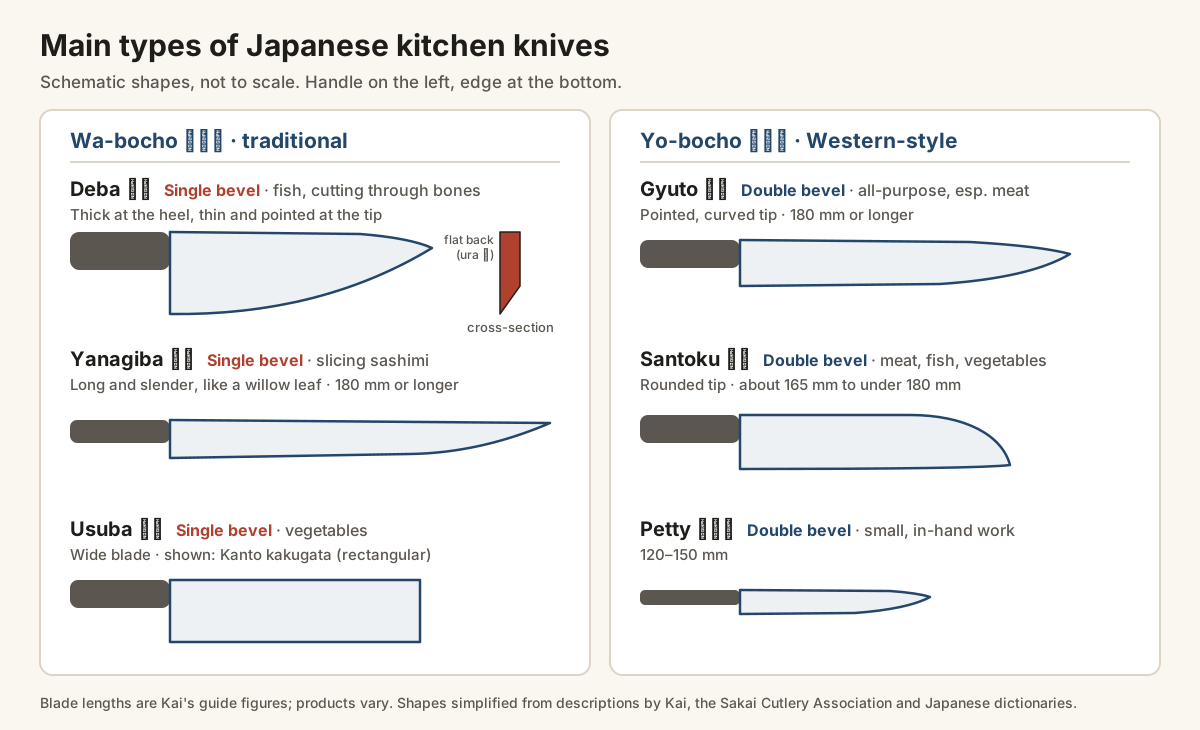
Most of the unfamiliar names in a Japanese knife shop belong here. Names often point to a job, a fish or a region, and most of these knives are single-edged.
| Term | Japanese | Reading | Meaning |
|---|---|---|---|
| Wa-bocho | 和包丁 | wa-bocho | Traditional Japanese kitchen knives, in shapes made for fish, vegetables and other jobs. A Tokyo Metropolitan Board of Education resource says they take the Japanese sword as their prototype. See types of Japanese knives. |
| Deba | 出刃 | deba | A single-edged fish knife, thick at the heel and thin and pointed at the tip, for filleting fish and cutting through fish bones. |
| Mioroshi | 身卸 | mioroshi | A fish knife, thinner and narrower than a deba. |
| Funayuki | 船行 | funayuki | A fish knife suited to filleting. Said to have gone to sea with fishermen for simple cooking and cutting bait. |
| Yanagiba | 柳刃 | yanagiba | The long, single-edged sashimi knife of Kansai, 180 mm or longer. The name compares its shape to a willow or iris leaf. |
| Takohiki | 蛸引 | takohiki | The Kanto-style (Tokyo) sashimi knife, single-edged like the yanagiba. |
| Usuba | 薄刃 | usuba | A single-edged vegetable knife with a wide blade and a sharp edge angle, made so vegetables are easy to cut. Kansai and Kanto shapes are listed under Edge, bevel and shape (kamagata, kakugata). |
| Nakiri | 菜切 | nakiri | A vegetable knife for chopping, peeling and chamfering. Unlike most traditional knives, it is double-edged. Its two regional shapes (azumagata, nishigata) are under Edge, bevel and shape. |
| Kiritsuke | 切付 | kiritsuke | An everyday do-everything knife that, Tsukiji Aritsugu says, served until recently as a kind of Japanese-style gyuto and is less often seen today. Aritsugu’s model is single-edged. |
| Hamo honekiri | はも骨切 | hamo honekiri | A specialist knife for cutting the small bones of pike conger (hamo). |
| Unagi-saki | うなぎ裂 | unagi-saki | A knife for filleting eels, made in Osaka, Kyoto, Edo and Nagoya/Ise patterns. |
| Men-bocho | 麺包丁 | men-bocho | A knife for cutting udon and soba noodles, which cuts cleanly under its own weight. |
Western-style and all-purpose knives (yo-bocho)
These are the knives most home cooks end up with. If you can’t decide between them, our guide to gyuto, santoku and bunka compares the three.
| Term | Japanese | Reading | Meaning |
|---|---|---|---|
| Yo-bocho | 洋包丁 | yo-bocho | Double-edged, Western-style knives, which arrived in Japan with Western cooking from the Meiji era (1868 on). |
| Santoku | 三徳 | santoku | A double-edged, all-purpose knife combining elements of the nakiri, the sashimi knife and the gyuto, about 165 mm to under 180 mm long. |
| Gyuto | 牛刀 | gyuto | Literally “beef knife”: a double-edged, all-purpose knife with a pointed tip, 180 mm or longer. |
| Bunka bocho | 文化包丁 | bunka bocho | An all-purpose household knife. Japanese sources often treat it as another name for the santoku, while one dictionary describes a spine cut at an angle and a pointed tip. |
| Petty | ペティ | peti | A small double-edged knife of 120–150 mm, for in-hand work and detailed cutting. |
| Honesuki | 骨すき | honesuki | A boning knife, for dealing with bones. Kai includes one in its Western-style range. |
Edge, bevel and shape
A knife’s edge decides how it feels in the hand and how you sharpen it. The shape terms below also explain why two knives with the same job can look quite different.
| Term | Japanese | Reading | Meaning |
|---|---|---|---|
| Kataba | 片刃 | kataba | Single-edged: the cutting bevel is ground on one face only, and the back face is left nearly flat with a hollow in it (see ura). As it cuts, the edge drifts slightly to the left, according to Tsukiji Aritsugu. Most traditional knives are kataba. |
| Ryoba | 両刃 | ryoba | Double-edged: ground at roughly the same angle on both faces. Santoku and gyuto are ryoba and suit either hand. |
| Ura | 裏 | ura | The back of a single-edged blade, the face that goes against the whetstone. It is not perfectly flat but hollowed (ura-suki, 裏スキ). Lay it flat on the stone when sharpening, Kiya advises. |
| Kamagata | 鎌型 | kamagata | “Sickle-shaped”: the pointed Kansai shape of usuba. Kiya also sells a kamagata nakiri. |
| Kakugata | 角型 | kakugata | “Square-shaped”: the rectangular Kanto shape of usuba. |
| Azumagata | 東型 | azumagata | The “eastern” pattern of nakiri in Kiya’s catalogue. |
| Nishigata | 西型 | nishigata | The “western” pattern of nakiri in Kiya’s catalogue. |
Steel and construction
This is the group to check when two knives that look alike have very different prices. Kai and the Sakai Cutlery Association say a knife’s price depends mainly on the blade material and on how precisely it is worked.
| Term | Japanese | Reading | Meaning |
|---|---|---|---|
| Jigane | 地金 | jigane | The soft iron body of a laminated blade. |
| Hagane | 刃金 | hagane | The hard edge steel joined to the jigane. Sakai City describes the two being heated red-hot in a furnace and hammered out until they bond. The word is also used loosely for carbon steel in general. |
| Awase | 合わせ | awase | Laminated construction: steel joined onto the edge of a soft iron body. This makes the edge less likely to chip and gives it some flexibility, says Tsukiji Aritsugu. |
| Honyaki | 本焼 | honyaki | A knife made entirely from one piece of steel, hardened under a layer of clay and suited to experienced, skilled cooks, as Kiya describes it. |
| Three-layer clad steel | 三層鋼 | sansoko | A steel core between less expensive outer layers. Takefu Special Steel says it is the most widely used knife material. |
| Warikomi | 割込 | warikomi | A construction in which steel is set into a split in soft iron; after hardening the soft iron is ground away on both sides so the steel core forms the edge. It is used for double-edged knives such as nakiri and santoku. Kai also uses warikomi-zai (割り込み材) for a composite material, so the word can mean either. |
| Damascus | ダマスカス | damasukasu | Many layers of different metals bonded to the sides of a blade, which show a distinctive pattern when ground. On most Damascus knives, the core steel does the cutting, not the pattern. |
| Hamon | 刃紋 | hamon | The pattern that appears on a blade through hardening (quenching). It is a different thing from the layered pattern of Damascus. Dictionaries write it 刃文, and Kiya writes 波紋 for the pattern on clay-hardened honyaki. |
| Shirogami | 白紙 | shirogami | “White paper” carbon steel from Proterial in Yasugi. A Niigata research institute calls it a premium knife steel with few impurities that is hard to harden (quench). |
| Aogami | 青紙 | aogami | “Blue paper” steel: shirogami with chromium and tungsten added for better heat treatment and wear resistance. It costs more because the alloying elements are expensive. |
| Gingami | 銀紙 | gingami | “Silver paper”: a stainless knife steel. Tsukiji Aritsugu lists it as stainless and rust-resistant. |
| Aigami | 藍紙 | aigami | A Proterial knife steel launched in December 2025, presented as a new category that is neither carbon nor stainless steel. |
| VG10 | V金10号 | — | V-Gold No. 10, a stainless knife steel developed by Takefu Special Steel in Echizen. It is hardened to HRC 60 or above and known for corrosion resistance and ease of sharpening. |
| SG2 | スーパーゴールド2 | — | Super Gold 2, a powder-metallurgy stainless steel from Takefu Special Steel, which abbreviates it SPG2. It is hardened to HRC 62 or above, and its composition is not published. |
| Kasumi | 霞 | kasumi | “Mist”: the finish usually given to laminated knives. |
| Kido | 木砥 | kido | The finish usually given to the edge of honyaki knives. |
Forging and craft roles
In Sakai, forging, sharpening and handle fitting are separate specialities, which is why a Sakai blade can carry more than one person’s work. Echizen and Tosa each have techniques of their own, listed below.
| Term | Japanese | Reading | Meaning |
|---|---|---|---|
| Uchihamono | 打刃物 | uchihamono | Hand-forged blades. Seven kinds are designated as Traditional Crafts, including those of Sakai, Echizen, Tosa and Echigo-Sanjo. |
| Tanzo | 鍛造 | tanzo | Forging: the smith’s stage of heating steel and soft iron and hammering them into the shape of a blade. In Sakai it is one of three separate specialities, with sharpening and handle fitting. See also jiyu tanzo below. |
| Hagane-tsuke | 刃金つけ | hagane-tsuke | The first step in Sakai’s forging process listing: red-hot soft iron is hammered, the steel (coated with a bonding agent of boric acid, borax, iron oxide and the like) is laid on, and the two are heated in the furnace and hot-forged. |
| Hizukuri | 火造り | hizukuri | Hot forging. In Sakai’s process listing it is part of the hagane-tsuke step: the joined iron and steel are heated in the furnace and forged into shape. |
| Tansetsu | 鍛接 | tansetsu | Forge welding: joining metal by heating and hammering it. For knives, Jikko, a Sakai maker, says laminated (kasumi) knives involve it and honyaki knives do not. |
| Tsuchioki | 土置き | tsuchioki | Putting clay on a blade before quenching. Sakai makers describe it mainly for honyaki, and the sources do not say whether laminated knives get it too. Sakai’s process listing separately names a mud-coating step (泥塗り) before quenching, which helps the blade harden evenly; the sources do not say the two are the same. |
| Yakiire | 焼き入れ | yakiire | Quenching: in Sakai’s process listing the blade is heated to 750–800°C and plunged into water at once, which raises the hardness of the hagane. |
| Yakimodoshi | 焼きもどし | yakimodoshi | Tempering: after quenching the blade is heated again, which gives the hagane some toughness so the edge is less likely to chip. Sakai’s process listing notes that machines holding 160–180°C are now common. |
| Hatsuke | 刃付け | hatsuke | Putting the edge on a blade by sharpening, done by a specialist sharpener in Sakai. |
| Etsuke | 柄付け | etsuke | Fitting the handle, the last of Sakai’s three specialist stages. |
| Mawashi-hagane-tsuke | 廻し鋼着け | mawashi-hagane-tsuke | An Echizen technique used for tools such as sickles: the edge steel is flattened diagonally from one corner, giving a thin blade that is easy to sharpen. |
| Nimai-hiroge | 二枚広げ | nimai-hiroge | An Echizen technique of stacking two blades and hammering them together from both sides, which stretches the blades thin. One Japanese article calls it 二枚重ね instead. |
| Jiyu tanzo | 自由鍛造 | jiyu tanzo | “Free forging”, the Tosa method of making a tool from nothing more than an order sheet giving its shape and dimensions. |
| Deba-ya | 出刃屋 | deba-ya | A Sakai smith who makes thick blades such as deba. |
| Moroha-ya | もろ刃屋 | moroha-ya | A Sakai smith who makes double-edged knives such as nakiri, sushi knives and Chinese cleavers. |
| Usuba-ya | 薄刃屋 | usuba-ya | A Sakai smith who makes thinner blades, a fairly wide range that includes yanagiba and usuba. |
| Mino-den | 美濃伝 | mino-den | The Mino sword tradition of Seki, which had more than 300 swordsmiths at its peak. |
Care and sharpening
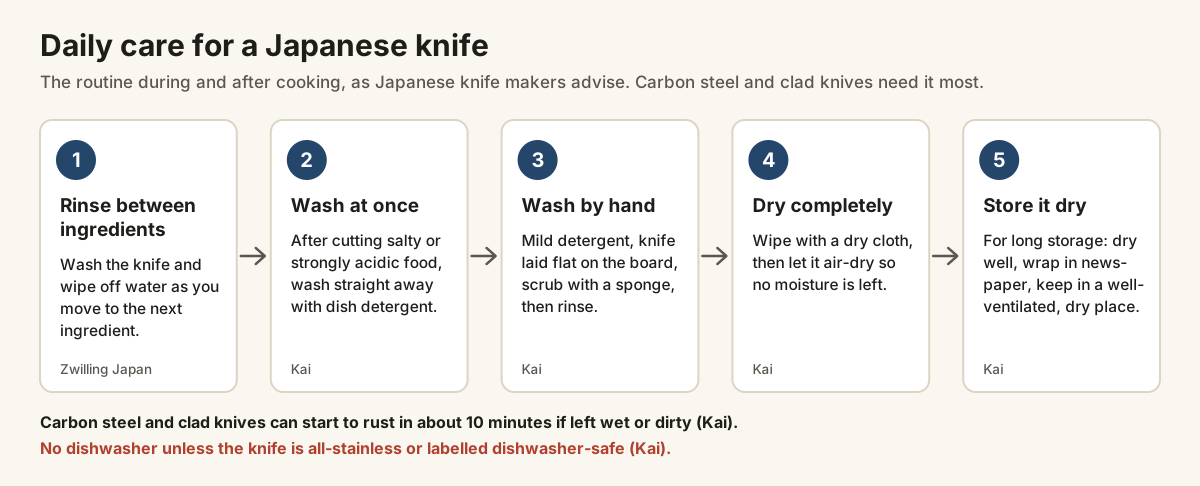
Rust is the first thing new owners of a steel knife run into. The terms below cover the stones and services you will meet; our guide to caring for and sharpening a Japanese knife goes into the method.
| Term | Japanese | Reading | Meaning |
|---|---|---|---|
| Toishi | 砥石 | toishi | A whetstone. Kai suggests sharpening once or twice a month. |
| Aratoishi | 荒砥石 | aratoishi | A coarse stone (about #300–400), for chips and rust. |
| Nakatoishi | 中砥石 | nakatoishi | A medium stone (about #800–1000), enough for routine sharpening (Kai). |
| Shiagetoishi | 仕上げ砥石 | shiagetoishi | A finishing stone (about #2000–3000). |
| Ban | 番 | ban | The grit number of a whetstone, as in “#1000”. Lower numbers are coarser. |
| Bo-toishi | 棒砥石 | bo-toishi | A sharpening rod. It does not create an edge; it cleans it and restores cutting for a while (Kai). |
| Toginaoshi | 研ぎ直し | toginaoshi | Resharpening by a professional. Kiya accepts only knives it sells; Sakai Denshokan and Gifu Seki Hamono Kaikan also take knives. Prices and turnaround change, so check each shop; see knife-making experiences in Japan. |
| Manaita | まな板 | manaita | A cutting board. Wood is preferred for its natural feel when the knife meets it, while some foods slip on glass or stainless boards (Kai). |
Places, shops and makers
Japanese knives are often named for their town. Seki in Gifu leads Japan in recorded kitchen-knife shipments, while Sakai, Echizen, Tosa and Sanjo are among the towns whose forged blades are designated Traditional Crafts. See Japan’s knife towns compared for the towns side by side.
Towns and regions
| Term | Japanese | Reading | Meaning |
|---|---|---|---|
| Sakai | 堺 | Sakai | A knife town in Osaka Prefecture, known for knives used by professional chefs and for a division of labour among smiths, sharpeners and handle fitters. |
| Echizen | 越前 | Echizen | Echizen City, Fukui. In 1979 it became the first blade-making area designated a Traditional Craft. |
| Tosa | 土佐 | Tosa | Kochi Prefecture, known for free forging and blades for farming and forestry. |
| Sanjo | 三条 | Sanjo | Sanjo City, Niigata, which makes kitchen knives alongside planes, chisels and other tools. |
| Seki | 関 | Seki | Seki City, Gifu: Japan’s largest kitchen-knife producer by recorded shipment value, with roots in swordmaking. |
| Yasugi | 安来 | Yasugi | The city in Shimane where Proterial makes shirogami and aogami steel. |
| Kansai | 関西 | Kansai | Western Japan around Osaka and Kyoto, home of the yanagiba and the kamagata usuba. |
| Kanto | 関東 | Kanto | Eastern Japan around Tokyo, home of the takohiki and the kakugata usuba. |
| Kappabashi Dogu Street | かっぱ橋道具街 | Kappabashi Dogu-gai | Tokyo’s kitchenware street, with about 160 shops. |
Shops, museums, workshops and makers
These are the places and companies that appear in our other guides.
| Term | Japanese | Reading | Meaning |
|---|---|---|---|
| Sakai Denshokan | 堺伝匠館 | Sakai Denshokan | Sakai’s traditional crafts hall, home to the Sakai Hamono Museum “CUT” (堺刃物ミュージアム「CUT」) and a venue for craft demonstrations. It also takes knives for resharpening. See knife-making experiences in Japan. |
| Takefu Knife Village | タケフナイフビレッジ | — | A shared workshop of 14 knife companies in Echizen, with factory viewing and knife-making and sharpening classes. See knife-making experiences in Japan. |
| Sanjo Kaji Dojo | 三条鍛冶道場 | Sanjo Kaji Dojo | A blacksmithing centre in Sanjo offering knife-sharpening and traditional nail-making sessions. |
| Seki Kaji Denshokan | 関鍛冶伝承館 | Seki Kaji Denshokan | Seki’s swordsmith museum. Its English name is not fixed: Seki’s tourism site uses both “Seki Sword Tradition Museum” and “Seki Traditional Swordsmith Museum”. Opening status changes, so see knife-making experiences in Japan and the city’s page. |
| Gifu Seki Hamono Kaikan | 岐阜関刃物会館 | Gifu Seki Hamono Kaikan | Gifu Seki Cutlery Hall, in Seki, selling around 2,000 items from more than 70 companies, with sharpening and resharpening. |
| Kiya | 日本橋木屋 | Nihonbashi Kiya | A knife shop in Nihonbashi, Tokyo. |
| Tsukiji Aritsugu | 築地有次 | Tsukiji Aritsugu | A knife shop in Tsukiji, Tokyo, begun in Nihonbashi in 1918. It is a separate shop from Aritsugu (有次) in Kyoto. |
| Kai | 貝印 | Kaijirushi | Kai Corporation (貝印株式会社, KAI Corporation in English), a Japanese cutlery maker. |
| Takefu Special Steel | 武生特殊鋼材 | — | A steelmaker in Echizen City that developed VG10 and SG2. |
| Proterial | プロテリアル | — | The steelmaker behind shirogami, aogami and aigami, known as Hitachi Metals until January 2023. |
Labels, certification and history
A label is one of the few places where a seller’s claim can be checked against something official. Many good knives carry no label, and a missing label does not make a knife a fake. Our guide to telling an authentic Japanese knife shows how to use these terms. Two historical entries at the end show where Sakai’s reputation began.
| Term | Japanese | Reading | Meaning |
|---|---|---|---|
| Dentoteki kogeihin | 伝統的工芸品 | dentoteki kogeihin | Traditional Crafts of Japan, designated by the Minister of Economy, Trade and Industry. It is a legal designation, not a quality grade. |
| Dento shoshi | 伝統証紙 | dento shoshi | A certification sticker showing that a designated craft item passed an inspection by its producers’ association. |
| Dento mark | 伝統マーク | dento mark | The official mark printed on the dento shoshi. |
| Chiiki dantai shohyo | 地域団体商標 | chiiki dantai shohyo | A regional collective trademark, filed by a group such as a producers’ cooperative for its members. It cannot be transferred to outsiders. It can be looked up in Japan’s trademark register. |
| Sakai Uchihamono | 堺打刃物 | Sakai uchihamono | Sakai’s forged blades: a Traditional Craft since 1982 and a regional collective trademark. |
| Sakai Hamono | 堺刃物 | Sakai hamono | “Sakai cutlery”, a regional collective trademark held by Sakai’s cutlery federation. |
| Echizen Uchihamono | 越前打刃物 | Echizen uchihamono | Echizen’s forged blades: a Traditional Craft since 1979 and a regional collective trademark. |
| Tosa Uchihamono | 土佐打刃物 | Tosa uchihamono | Tosa’s forged blades: a Traditional Craft since 1998 and a regional collective trademark. |
| Echigo Sanjo Uchihamono | 越後三条打刃物 | Echigo Sanjo uchihamono | Sanjo’s forged blades, designated a Traditional Craft in 2009. |
| Seki no Hamono | 関の刃物 | Seki no hamono | “Seki cutlery”, Seki’s regional collective trademark, registered in 2008. Trademark registration and Traditional Craft designation are separate systems. |
| Gensankoku | 原産国 | gensankoku | Country of origin. Japan’s Consumer Affairs Agency defines it as the country where the product’s content was substantially changed. |
| Sakai-kiwame | 堺極 | Sakai-kiwame | A historic stamp of approval. The Tokugawa shogunate let Sakai sell tobacco knives under this mark, which spread the town’s reputation. |
| Tabako-bocho | たばこ包丁 | tabako-bocho | A knife for shredding tobacco leaves, made in Sakai from the Tensho era (1573 on). |
Summary
- Work backwards from the product page: identify the knife type first, then its edge and its steel, and finally the place and label.
- Keep reading: knife types for the shapes, authentic knives for labels, care and sharpening for stones, and Japan’s knife towns for places.
Sources
- https://kougeihin.jp/craft_industry/kane/
- https://kougeihin.jp/craft/0710/
- https://kougeihin.jp/craft/0709/
- https://kougeihin.jp/craft/0713/
- https://kougeihin.jp/craft/0706/
- https://www.kyoiku.metro.tokyo.lg.jp/documents/d/kyoiku/dentou_suishinsiryo031
- https://www.kai-group.com/products/special/hocho/select/wa/
- https://www.kai-group.com/products/special/hocho/select/you/
- https://www.kai-group.com/support/faq/cooking/knife/
- https://www.kai-group.com/media/kitchen/167/
- https://www.kai-group.com/products/special/hocho/use/manaita/
- https://www.kai-group.com/global/about/company.html
- https://www.sakaihamono.or.jp/hamono01.html
- https://www.sakaihamono.or.jp/hamono02.html
- https://www.sakaihamono.or.jp/hamono05_a.html
- https://www.sakaihamono.or.jp/hamono06_a.html
- https://www.sakaihamono.or.jp/qanda.html
- https://www.sakaihamono.or.jp/museum07.html
- https://kotobank.jp/word/鍛接-1198503
- https://www.jikko.jp/c/glossary/chi-tsuchioki
- https://www.jikko.jp/c/knowledge/detail/kouzou/honyaki-knife
- https://hocho.ichimonji.co.jp/types/japanese-style-knives/hon-yaki-hocho-structure/
- https://hocho.ichimonji.co.jp/types/japanese-style-knives/japanese-style-knives-structure/
- https://e-hamono.net/html/kind.html
- https://intojapanwaraku.com/rock/craft-rock/44542/
- https://kotobank.jp/word/刃文-1198569
- https://www.kiya-hamono.co.jp/item/catalog2.html
- https://www.kiya-hamono.co.jp/mainte/togi.html
- https://www.kiya-hamono.co.jp/mainte/sharpening_repair.html
- https://www.kiya-hamono.co.jp/mainte/sabitori.html
- https://www.takefu-knifevillage.jp/experience
- https://hamono-net.or.jp/包丁について/包丁の種類/
- https://aritsugu.jp/
- https://aritsugu.jp/包丁の説明/
- https://aritsugu.jp/特製切付包丁/
- https://aritsugu.co.jp/w/aboutus/
- https://kotobank.jp/word/文化包丁
- https://kotobank.jp/word/牛刀
- https://www.kai-group.com/fun/event/edgemuseum/history/
- https://www.sakaihamono.or.jp/museum02.html
- https://visitseki.jp/?p=1245
- https://www2.jpx.co.jp/disc/54860/140120220925535615.pdf
- https://monoist.itmedia.co.jp/mn/spv/2301/13/news053.html
- https://www.pref.niigata.lg.jp/uploaded/attachment/430811.pdf
- https://www.pref.niigata.lg.jp/uploaded/attachment/430808.pdf
- https://www.pref.niigata.lg.jp/sec/chiikishinko/1356804108095.html
- https://www.proterial.com/press/2025/n1209.html
- https://e-tokko.com/v_gold_10.php
- https://e-tokko.com/spg2.php
- https://e-tokko.com/clad_metal.php
- https://www.zwilling.com/jp/magazine/product-guide-knives/about_damascus.html
- https://www.city.seki.lg.jp/cmsfiles/contents/0000004/4761/kogyo_R4.pdf
- https://www.city.seki.lg.jp/kanko/0000001558.html
- https://www.city.sakai.lg.jp/kanko/sakai/keisho/dentosangyo/sakaiuchihamono.html
- https://www.city.sakai.lg.jp/yoyakuanai/bunrui/sangyo/dentosangyo.html
- https://www.jpo.go.jp/system/trademark/gaiyo/chidan/shoukai/ichiran/bunya.html
- https://www.jpo.go.jp/system/trademark/gaiyo/chidan/faq.html
- https://www.caa.go.jp/policies/policy/representation/fair_labeling/representation_regulation/case_005/
- https://osaka-info.jp/experience/ja/osaka/spot/366
- https://fuku-iro.jp/spot/detail_10237.html
- https://niigata-kankou.or.jp/spot/detail_5735.html
- https://www.kankou-gifu.jp/spot/detail_7187.html
- https://www.gotokyo.org/jp/spot/59/index.html