The True Story of Kintsugi: What Japanese Sources Actually Say
Takumi Path is reader-supported. Some links on this page are affiliate links: if you buy or book through them, we may earn a commission at no extra cost to you. Learn more.
Key points
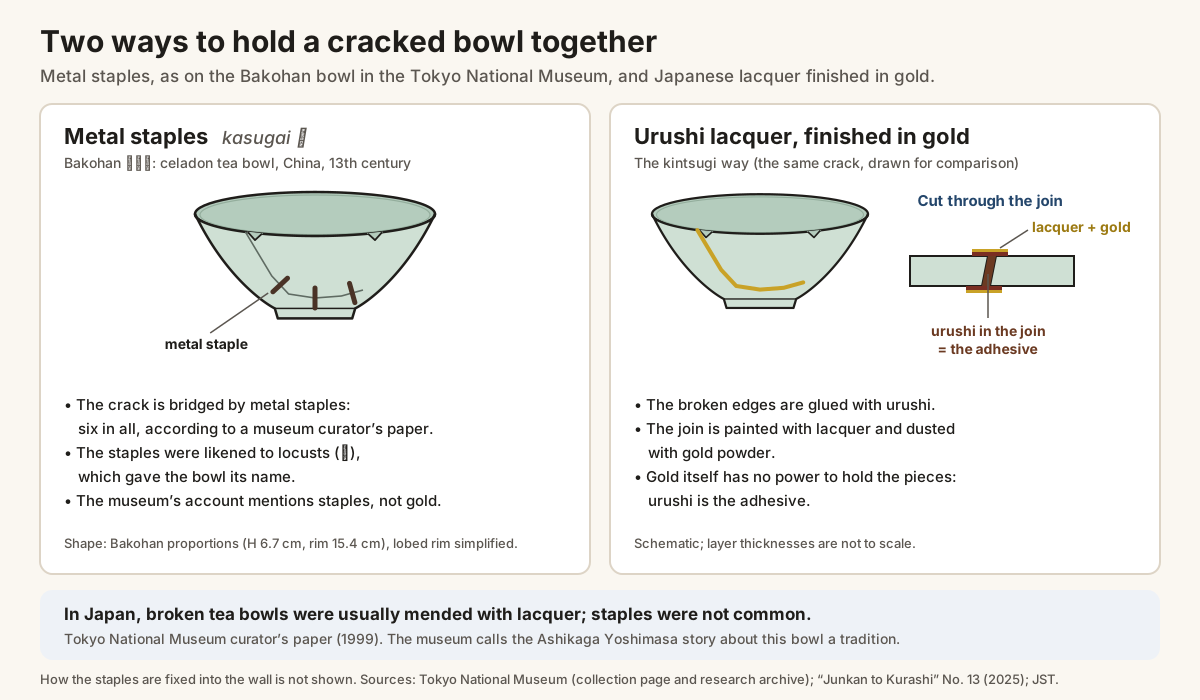
- Kintsugi is a repair: urushi (Japanese lacquer) is the adhesive, and gold powder is the finish on top.
- Pottery mended with lacquer has been found at a Jomon-period site in Tokyo, from roughly 4,000 to 3,000 years ago.
- The Tokyo National Museum describes its famous bowl Bakohan as held together with metal staples, and calls the Ashikaga Yoshimasa story a tradition.
- Records from the tea world of Sen no Rikyu's time mention urushi-tsugi (lacquer joining), but the word kintsugi does not seem to appear in them.
- A late Edo-period text says valuable tea wares were mended with lacquer and gold, and everyday pottery with a cheaper method called yakitsugi.
Contents
- What kintsugi is (and what holds it together)
- The story often told: Ashikaga Yoshimasa and the cracked tea bowl
- What the Tokyo National Museum says about Bakohan
- The bowl itself
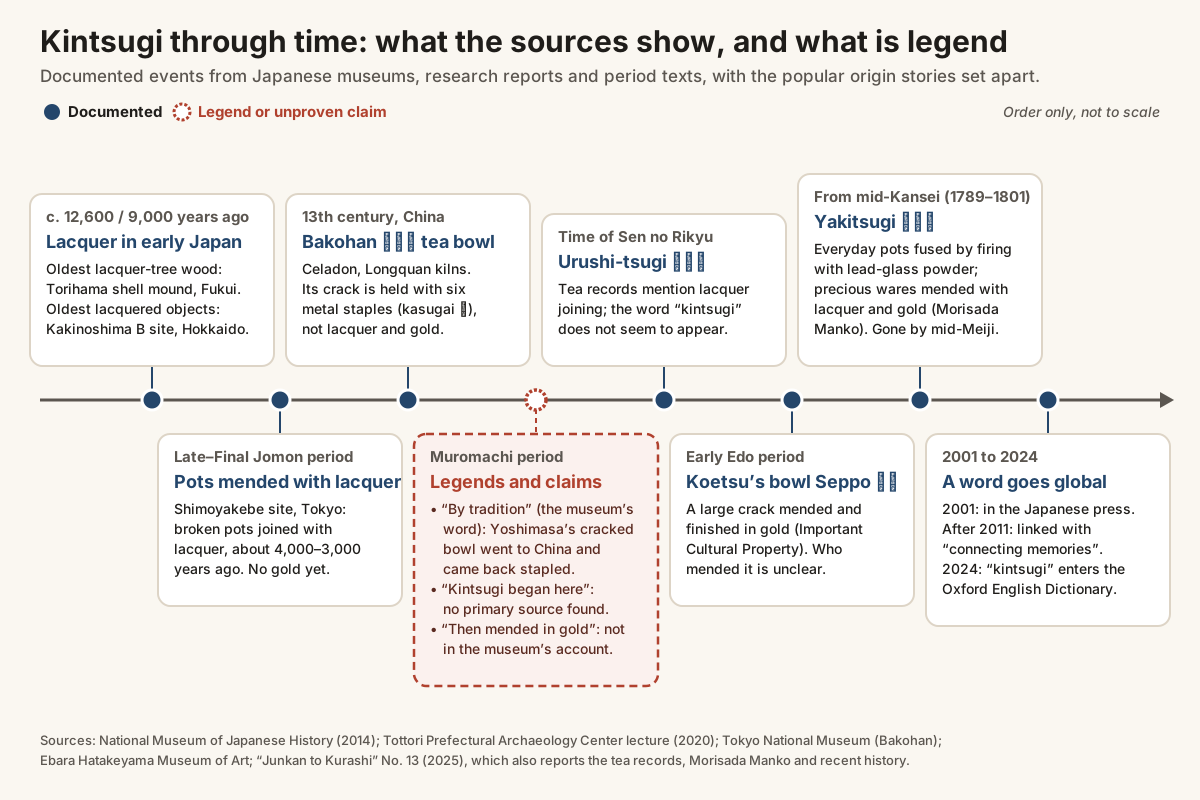
- What we can say with confidence: a timeline
- Jomon pottery mended with lacquer
- Lacquer joining in the world of tea
- Koetsu’s tea bowl Seppo
- Yakitsugi: the everyday alternative
- Fact or tradition? A quick reference
- Kintsugi and “wabi-sabi”: how it is understood in Japan
- Seeing kintsugi for yourself
- Summary
Kintsugi (金継ぎ) is the Japanese way of mending broken ceramics with urushi (漆, Japanese lacquer) and finishing the repair line with gold. It has become famous far beyond Japan, and so has a story about how it began: a shogun, a cracked Chinese tea bowl, and craftsmen who turned the damage into gold.
That story is worth a closer look. In this article we set the version often told in English beside what Japanese sources say, above all the Tokyo National Museum (東京国立博物館), which owns the bowl at the centre of the story. We also trace what is actually documented, from lacquer repairs on prehistoric pottery to the repair trades of the Edo period (江戸時代).
What kintsugi is (and what holds it together)
A Kyoto lacquer shop that repairs ceramics, Tsutsumi Asakichi Urushi (堤淺吉漆店), defines kintsugi simply as a traditional technique of repairing with lacquer and gold.
The order of those two words matters. A 2025 article in Junkan to Kurashi (循環とくらし), a magazine for general readers published by the Japan Society of Material Cycles and Waste Management (廃棄物資源循環学会), explains that gold itself has no power to join broken pieces: the adhesive is lacquer. The article is an essay by someone who works with Japanese collections at a British university library, not a peer-reviewed paper, so we use it alongside museum and research sources. It sets out three related terms:
| Term | Japanese | What it means |
|---|---|---|
| Urushi-tsugi | 漆継ぎ | Pieces joined with lacquer only |
| Kintsugi | 金継ぎ | The joint is coated with lacquer again and finished with gold powder |
| Gintsugi | 銀継ぎ | The same, finished with silver powder |
The finishing step works on the same principle as maki-e (蒔絵), the decorative technique of sprinkling gold or other metal powder onto lacquer before it dries. Maki-e was designated an Important Intangible Cultural Property (重要無形文化財) in 1955.
The article also notes that kintsugi was traditionally done by nushi (塗師), specialists in lacquer work, and that the job title “kintsugi-shi” (金継ぎ師) seems to be more recent. For how the repair is done step by step, see our guide to the kintsugi process.
The story often told: Ashikaga Yoshimasa and the cracked tea bowl
In English, the origin of kintsugi is often told roughly like this. The shogun Ashikaga Yoshimasa (足利義政) broke a treasured Chinese tea bowl and sent it to China for repair. It came back held together with ugly metal staples, so he asked Japanese craftsmen to find a more beautiful method, and they invented kintsugi.
The bowl in this story is real. It is a 13th-century celadon tea bowl known as Bakohan (馬蝗絆), and it is in the collection of the Tokyo National Museum. So the most direct way to check the story is to read what the museum itself says.
What the Tokyo National Museum says about Bakohan
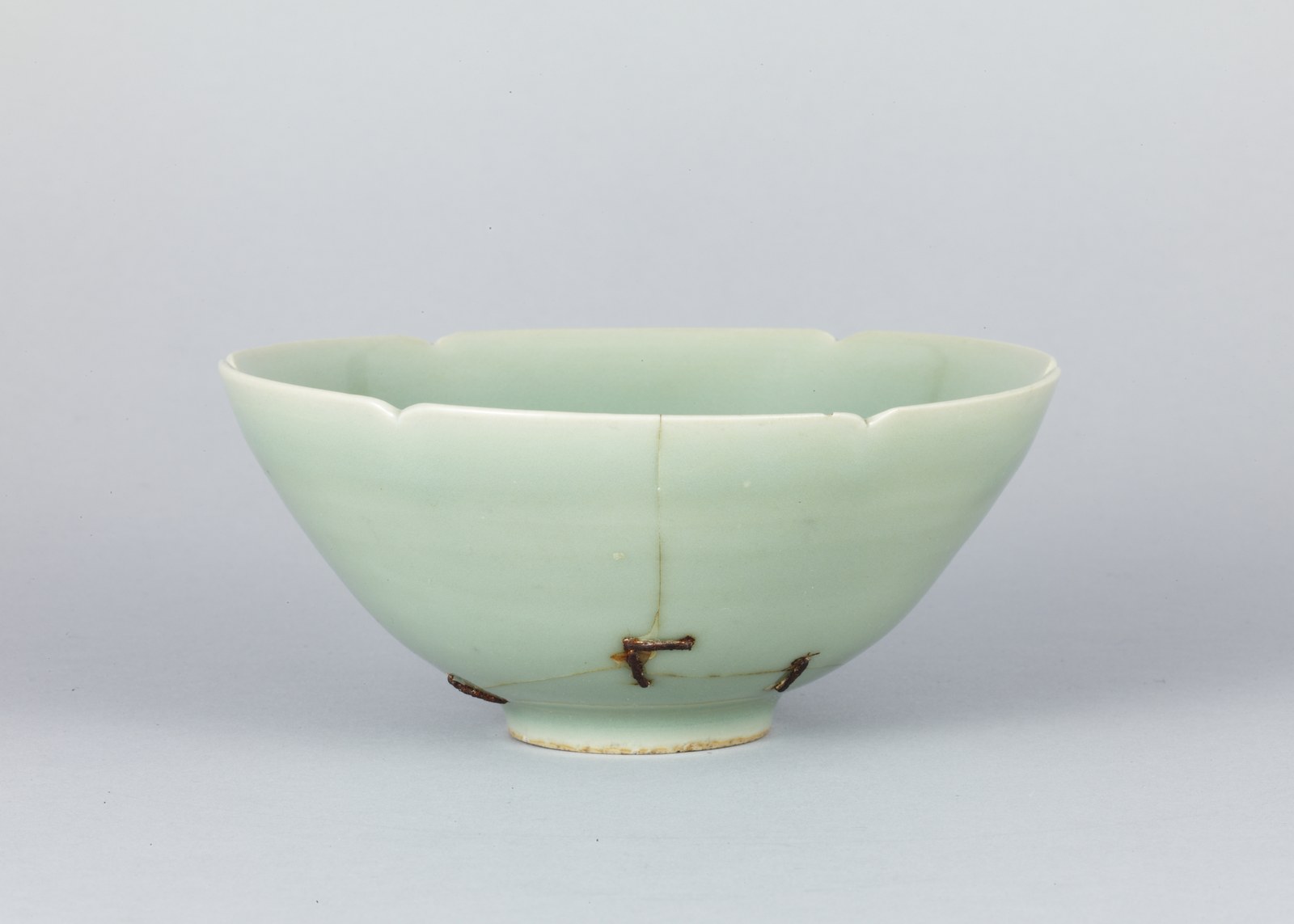
The museum’s collection page describes the bowl as follows (our summary of the Japanese text):
According to tradition, when the bowl belonged to Ashikaga Yoshimasa, a crack appeared. He sent it to China asking for a replacement, but Ming-dynasty China no longer had anything like it, and the bowl was sent back fastened with kasugai (鎹, metal staples). The staples were likened to locusts (inago, 蝗), and the bowl was named Bakohan.
Three things stand out:
- The repair is made with staples, not gold. The bowl’s name comes from the staples themselves. A research paper by a Tokyo National Museum curator (published in 1999) explains that the crack was mended with six staples.
- The museum calls the Yoshimasa episode a tradition (伝承), not established history.
- Kintsugi does not appear in the story at all. The museum’s account ends with the staples and the name. It says nothing about Japanese craftsmen inventing a gold repair in response.
The same paper adds useful context. In Japan, it says, lacquer was the usual way to mend a broken tea bowl, and staples were not commonly used. That makes Bakohan’s repair unusual in Japan, rather than an example of a Japanese method. The paper also examines an 18th-century account of the bowl, Bakohan Chaoki (馬蝗絆茶甌記, 1727) by Ito Togai (伊藤東涯), and concludes that part of the history it gives, that the bowl was once presented to Taira no Shigemori (平重盛), is hard to accept as fact.
| The story often told | What the Tokyo National Museum says | |
|---|---|---|
| How the bowl was mended | Badly, with staples, so Yoshimasa looked for a better way | With staples (six, according to the curator’s paper). The staples gave the bowl its name |
| Yoshimasa’s role | Owner who prompted the invention of kintsugi | Owner “according to tradition” |
| Gold repair | Invented by Japanese craftsmen as a result | Not mentioned |
| Normal repair in Japan | — | Lacquer; staples were not common |
The bowl itself
| Item | Detail (Tokyo National Museum) |
|---|---|
| Name | Celadon tea bowl with lobed rim, known as Bakohan (青磁輪花茶碗 銘 馬蝗絆) |
| Date | Southern Song dynasty, 13th century |
| Made at | Longquan kilns (龍泉窯), China |
| Status | Important Cultural Property (重要文化財) |
| Size | Height 6.7 cm, mouth diameter 15.4 cm |
| On display? | No display dates were scheduled when we checked on 11 October 2026; check the museum’s site before visiting |
What we can say with confidence: a timeline
Setting the legend aside, Japanese sources do document a long history of mending with lacquer. Here is what they support, in order.
| Period | What happened | Source |
|---|---|---|
| About 12,600 years ago | Oldest known lacquer-tree wood in Japan, from the Torihama shell mound (鳥浜貝塚), Fukui | Tottori Prefecture archaeology lecture, citing the National Museum of Japanese History |
| About 9,000 years ago | Oldest known lacquered objects in Japan, from the Kakinoshima B site (垣ノ島B遺跡), Hokkaido | Same |
| Late and Final Jomon period, about 4,000–3,000 years ago | Broken pottery mended with lacquer at the Shimoyakebe site (下宅部遺跡), Higashimurayama, Tokyo | National Museum of Japanese History research report (2014); 2025 article |
| Time of Sen no Rikyu | Tea records mention urushi-tsugi (lacquer joining); the word kintsugi does not seem to appear | 2025 article |
| Early Edo period | A red Raku tea bowl by Hon’ami Koetsu, Seppo, shows a large crack mended and finished in gold | Hatakeyama Museum; 2025 article |
| From the mid-Kansei era (1789–1801) | Yakitsugi, mending by firing with glass powder, spreads for everyday pottery; valuable wares are still mended with lacquer and gold | Morisada Mankō, via the 2025 article |
| Mid-Meiji era | Yakitsugi menders are no longer seen | Same |
| 2001 to 2024 | A 2001 Nikkei evening-paper article covers kintsugi; after 2011 it is linked with “connecting memories”; the Oxford English Dictionary adds “kintsugi” in 2024 | 2025 article |
Jomon pottery mended with lacquer
The clearest early evidence comes from the Shimoyakebe site, a waterlogged site in Higashimurayama (東村山市), Tokyo, dating to the late and final phases of the Jomon period (縄文時代). A 2014 research report from the National Museum of Japanese History (国立歴史民俗博物館) studied the lacquer repairs on its pottery and showed how the type of damage, the repair method and the kind of lacquer used were related. The 2025 article describes pottery fragments from the site, about 4,000 to 3,000 years old, that were mended using lacquer as an adhesive.
This does not mean kintsugi itself began in the Jomon period. There was no gold finish. What it does show is that mending vessels with lacquer goes back thousands of years in Japan.
Lacquer joining in the world of tea
The tea ceremony, chanoyu (茶の湯), is where many people expect the kintsugi story to begin. The 2025 article discusses records of tea in the time of Sen no Rikyu (千利休), including Chawa Shigetsushu (茶話指月集), Sado Shiso Densho (茶道四祖伝書) and Yamanoue Soji Ki (山上宗二記). Its author reports, with some caution, that the word “kintsugi” does not seem to appear in them, while urushi-tsugi does.
So the tea world of that era was mending its wares with lacquer. The article does not say whether those repairs were finished in gold, or when gold finishing began.
Koetsu’s tea bowl Seppo
A well-documented example of gold mending on a tea bowl is a red Raku tea bowl by the artist Hon’ami Koetsu (本阿弥光悦), named Seppo (雪峯). It is an Important Cultural Property in the collection of the Ebara Hatakeyama Museum of Art (荏原 畠山美術館) in Shirokanedai, Tokyo, and a large crack across it is mended and finished in gold.
Who did the repair is less clear. Some accounts, including the 2025 article, say Koetsu mended the bowl himself, but we could not confirm this in the museum’s own text, so we do not repeat it as fact. The 2025 article suggests, as its own view, that gold repairs may have begun to be used in the tea world from the early Edo period onwards, when Seppo was made.
Yakitsugi: the everyday alternative
In the Edo period there was also a cheaper repair. Morisada Mankō (守貞謾稿, also written 守貞漫稿), Kitagawa Morisada’s (喜田川守貞) record of everyday life and customs in Kyoto, Osaka and Edo, describes it. Japanese reference works date it to between 1837 and 1853, with additions made later. In the 2025 article’s modern Japanese rendering, the text says that:
- in the past, broken pottery was always mended with lacquer;
- from the middle of the Kansei era (寛政, 1789–1801), a method called yakitsugi (焼継ぎ) began, in which pieces were fused by firing with shiratamako (白玉粉), a lead-glass powder;
- valuable pottery and tea wares were mended with lacquer and finished with gold powder, while everyday pottery was mended by yakitsugi.
The article adds that by the middle of the Meiji era (明治), yakitsugi menders were no longer to be seen.
Fact or tradition? A quick reference
| Claim | Status | What Japanese sources say |
|---|---|---|
| Japanese people have mended pottery with lacquer since the Jomon period | Supported | Lacquer repairs studied at the Shimoyakebe site (National Museum of Japanese History) |
| Gold is what holds a kintsugi repair together | Not correct | Lacquer is the adhesive; gold is the finish |
| Kintsugi was invented because of the stapled bowl Bakohan, said to have belonged to Yoshimasa | Not supported | The museum calls the Yoshimasa episode a tradition and describes the bowl as mended with staples; gold repair is not mentioned |
| Kintsugi began in the Muromachi period (室町時代) with the tea ceremony | Not confirmed | Often stated, but we found no primary evidence. Tea records of Rikyu’s time mention lacquer joining, not kintsugi |
| Gold repairs can be seen on tea wares from the early Edo period | Supported | Koetsu’s Seppo (Important Cultural Property) has a gold-finished repair |
| Koetsu repaired Seppo himself | Not confirmed | Not stated in the museum text we checked |
| In the late Edo period, fine wares were mended with lacquer and gold | Supported, via a secondary source | Morisada Mankō, as rendered in the 2025 article |
| Kintsugi is an officially designated Traditional Craft of Japan | Not correct | It is not on the national list of 244 designated crafts |
| Kintsugi grew out of the philosophy of wabi-sabi | Not confirmed | We found no Japanese primary source for this (see below) |
Kintsugi and “wabi-sabi”: how it is understood in Japan
Outside Japan, kintsugi is often presented as a philosophy of embracing imperfection, and linked to wabi-sabi (侘び寂び). The Oxford English Dictionary’s definition, added in 2024, includes this idea of an aesthetic or worldview that accepts imperfection.
The 2025 article in Junkan to Kurashi, written from Britain, compares the two views. In Britain, it says, ideas such as “accepting imperfection” and treating damage and its repair as part of an object’s history come to the fore. In present-day Japan, the common understanding is more down to earth: kintsugi is a technique for mending broken things, or a way to keep and treasure the memories attached to an object.
We did not find a Japanese primary source saying that kintsugi grew out of wabi-sabi thinking. That does not make the modern idea wrong as a personal way of seeing a mended bowl, but it is a modern interpretation rather than a documented origin.
Seeing kintsugi for yourself
- Bakohan is in the Tokyo National Museum. No display dates were scheduled when we checked, so look at the museum’s collection and exhibition pages before you go.
- Seppo belongs to the Ebara Hatakeyama Museum of Art in Tokyo, which showed it as a special exhibit in its winter 2026 exhibition (17 January to 22 March 2026). Works on display change from exhibition to exhibition, so check with the museum before you visit.
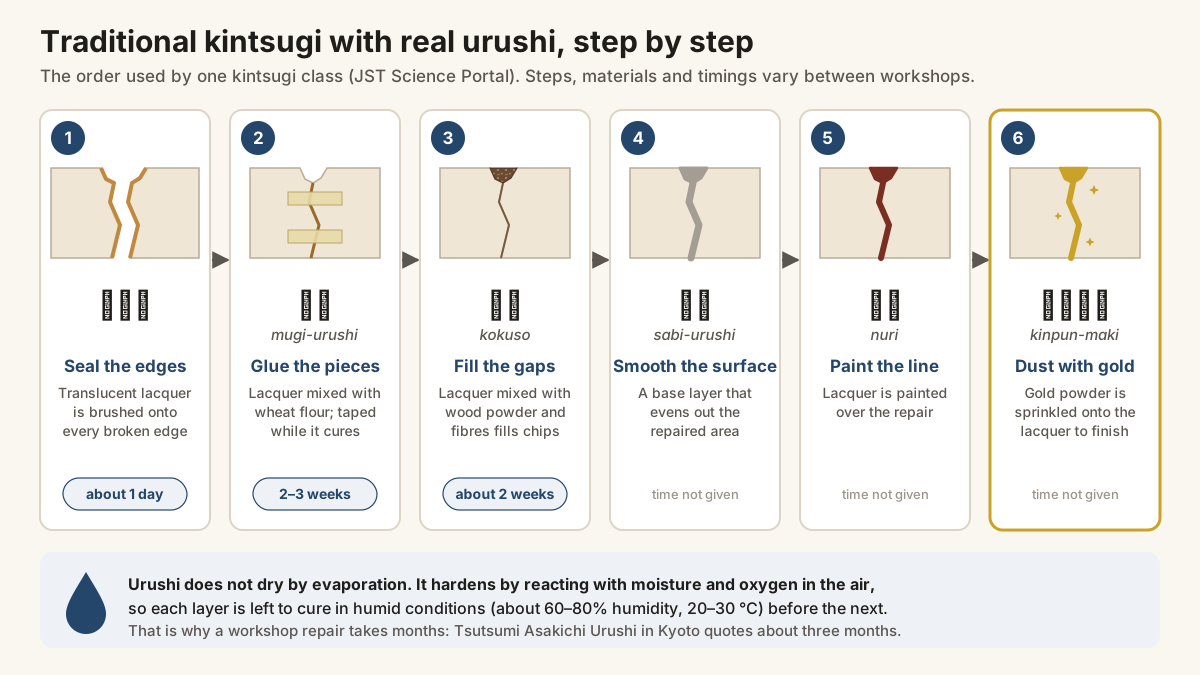
- Try or commission a repair: kintsugi studios in Tokyo and Kyoto offer repairs and classes. Our guide to the kintsugi process explains the steps and how long they take.
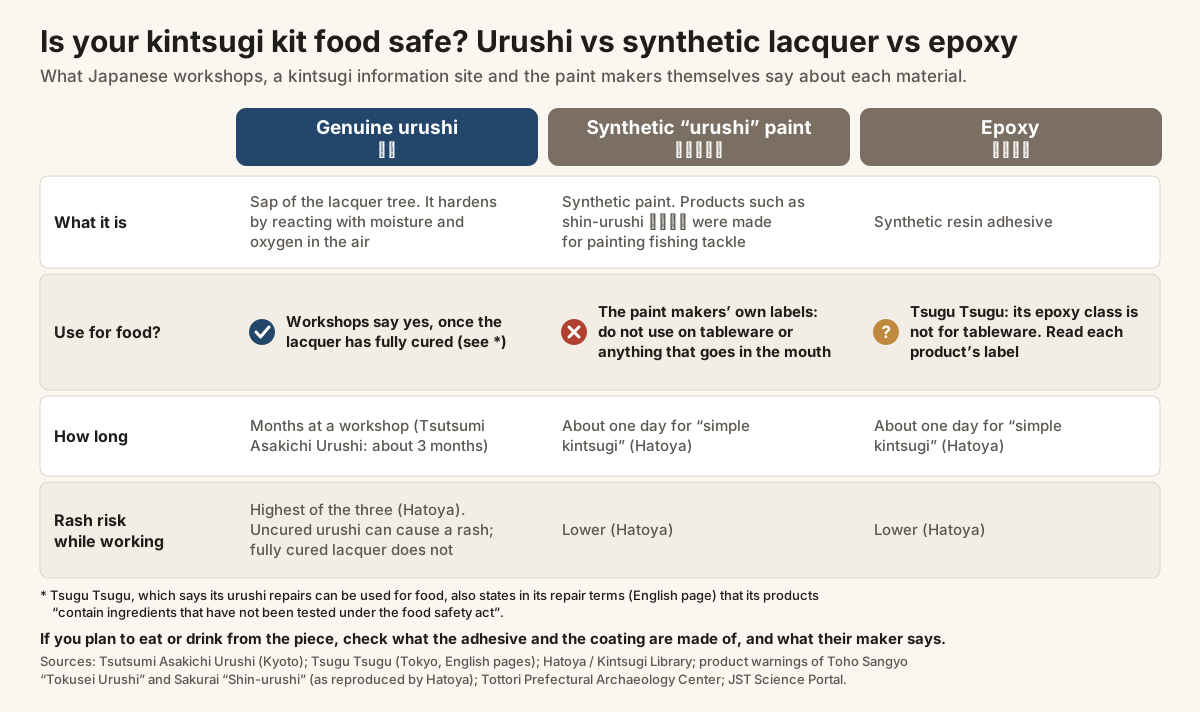
- Do it at home: if you want to try kintsugi yourself, our comparison of real urushi and epoxy kintsugi kits explains why the materials matter, especially for bowls you want to eat from.
Summary
- Kintsugi is a repair with lacquer as the adhesive and gold as the finish. Lacquer joining alone is urushi-tsugi.
- Mending pottery with lacquer goes back to the Jomon period, as finds from the Shimoyakebe site in Tokyo show.
- The famous Bakohan bowl is held together with metal staples. The Tokyo National Museum calls the Yoshimasa episode a tradition, and its account does not mention kintsugi.
- Tea records from Sen no Rikyu’s time mention lacquer joining but do not seem to use the word kintsugi. “Kintsugi began in the Muromachi period” is often said but not documented.
- Gold-finished repairs appear on tea wares from at least the early Edo period, such as Koetsu’s Seppo. In the late Edo period, fine wares were mended with lacquer and gold and everyday pottery by yakitsugi.
- In Japan, kintsugi is understood mainly as a practical repair and a way to keep treasured things, rather than as a philosophy.
Sources
- https://www.tnm.jp/modules/r_collection/index.php?controller=dtl&colid=TG2354
- https://webarchives.tnm.jp/research/details?id=1240
- https://jsmcwm.or.jp/journal/files/2025/09/050roberts-taira.pdf
- https://jsmcwm.or.jp/journal/?page_id=47
- https://kotobank.jp/word/%E5%AE%88%E8%B2%9E%E6%BC%AB%E7%A8%BF-142860
- https://www.ndl.go.jp/jikihitsu/part1/s2_3
- https://rekihaku.repo.nii.ac.jp/records/305
- https://www.pref.tottori.lg.jp/secure/1326827/0718urusi.pdf
- https://www.hatakeyama-museum.org/files/2026Winter_Flyer.pdf
- https://www.tsutsumi-urushi.com/kintsugi
- https://www.mlit.go.jp/tagengo-db/common/001653228.pdf
- https://kyokai.kougeihin.jp/wp/wp-content/uploads/2025/10/shitei-area_20251027.pdf