Kintsugi Workshops in Japan: Which Class Fits You, in Tokyo and Kyoto
Takumi Path is reader-supported. Some links on this page are affiliate links: if you buy or book through them, we may earn a commission at no extra cost to you. Learn more.
Key points
- In one session you cannot mend your own broken bowl from the start. The school supplies the pieces, and you take part in some of the steps.
- Uzumako and Tsugu Tsugu publish their steps; kulukulu lists none, so ask.
- Mending your own bowl takes a course of visits. Simple kintsugi (synthetic materials, brass powder) is a different thing from urushi kintsugi.
- On any booking site, ask five questions, starting with who runs the class and whether their own Japanese page says the same.
- Prices and rules were checked on November 2, 2026 and change often. Confirm with the school before you book.
Contents
Uzumako Ceramic Art School (うづまこ陶芸教室) in Tokyo’s Shiba (芝) is a pottery school first. For its kintsugi session, the school supplies damaged sake cups made by its teachers. You choose one, trace urushi (漆, Japanese lacquer) over the damage with a fine brush, and sprinkle powder onto it. The studio’s own page calls this a kintsugi experience with genuine urushi, “unusual for a single session.”
Kintsugi (金継ぎ) mends pottery with lacquer and gold, and real lacquer cannot be hurried. So in one session at a class in Tokyo (東京) or Kyoto (京都), you cannot mend your own broken bowl from the start. The school prepares the pieces, and you take part in some of the steps. Here is the short answer, drawn from the schools’ own Japanese pages.
- Real urushi and gold powder in one afternoon: a one-session class on a piece the school supplies (Uzumako, where tin powder is included and gold costs extra; Tsugu Tsugu (つぐつぐ); kulukulu’s one-day plan).
- Mending your own broken bowl: a course of visits.
- A cup to eat from: none of the genuine-urushi class pages we read says a same-day piece can go straight to food. Ask the school.
Kyoto has fewer choices. We found no genuine-urushi single session there with its price and steps on its own page: kulukulu publishes no price, and Tsugu Tsugu’s new Kyoto studio has so far only an opening notice, which gives the price but not the steps.
Three kinds of class
| Kind | What you do | Time | Materials |
|---|---|---|---|
| One-session class | Uzumako: trace lacquer, sprinkle powder. Tsugu Tsugu: one middle step plus a gold finish. kulukulu’s one-day plan: see below | 90 min to 3 hr | Genuine urushi |
| Course of visits | Your own broken bowl, start to finish (Tsugu Tsugu usually 8 to 10 visits; kulukulu 5 or more). Separate from these, kulukulu’s four-day plan (2 to 3 hr a day) is not described as mending your own bowl: it provides plates for each step | 2 to 3 months or more; or 4 days | Genuine urushi |
| “Simple” kintsugi | Glue and finish with synthetic materials | About 1 to 2 hr | Synthetic glue or gel, often brass powder |
A one-week visit fits the first and third kinds, and possibly the four-day plan. A course suits people who live nearby.
Why a bowl takes months, and what happens in between
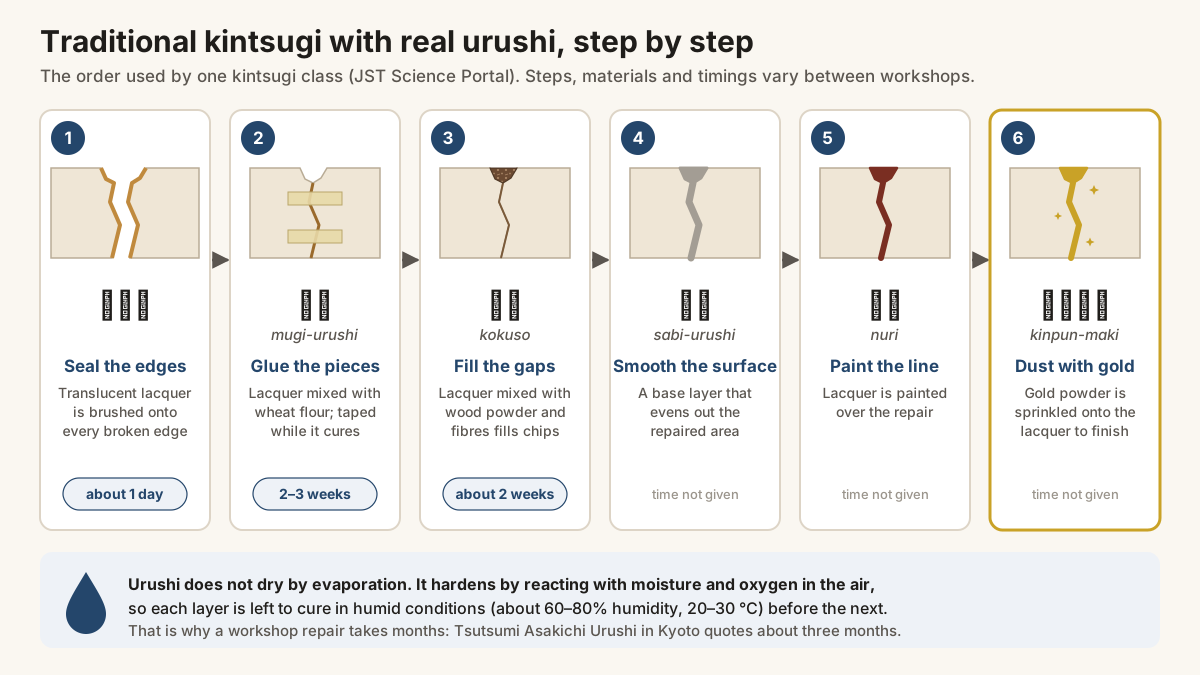
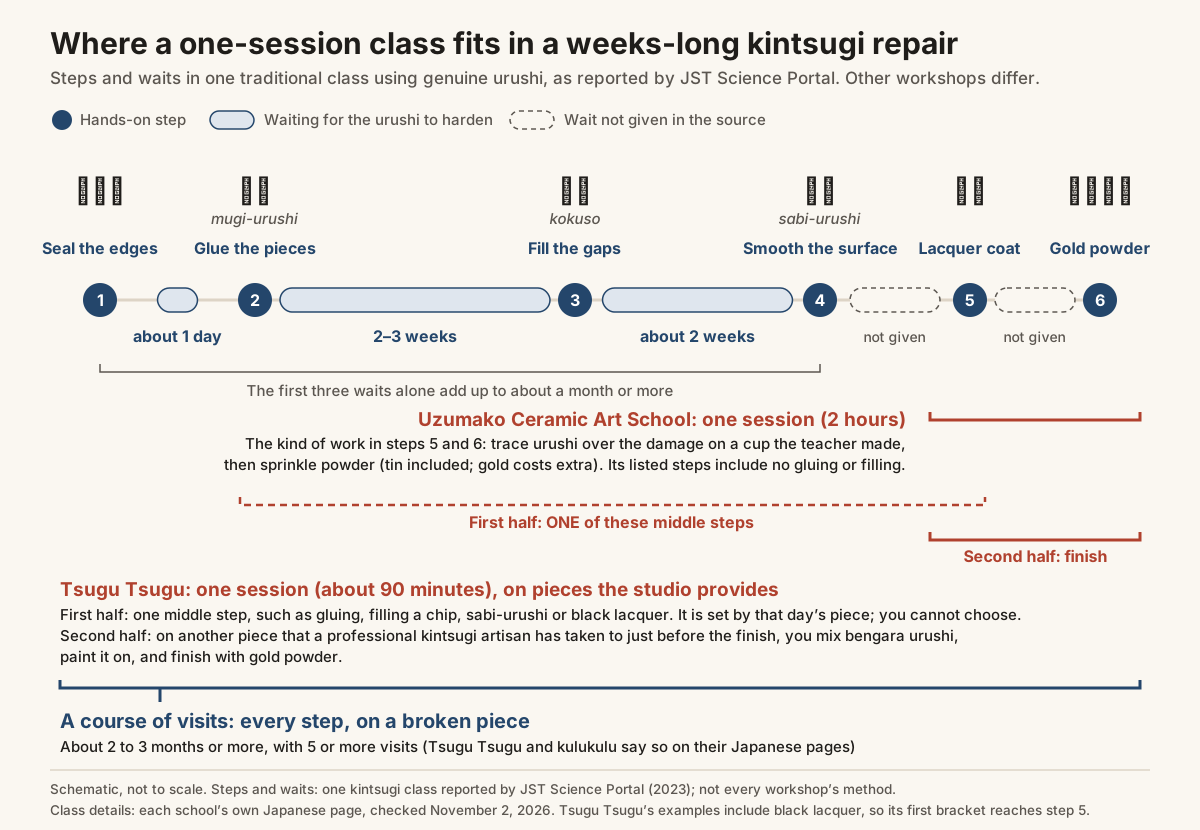
Urushi does not dry like paint. It hardens by reacting with moisture and oxygen, which is slow (the chemistry is in how traditional kintsugi works). Kyoto’s Tsutsumi Asakichi Urushi (堤淺吉漆店), which quotes about three months for a repair, says natural lacquer takes time to harden and comes out stronger when dried slowly. The Japan Science and Technology Agency (JST, 科学技術振興機構) followed one class through the steps:
- A first coat on the broken edges (漆固め): about a day to harden.
- Gluing with mugi-urushi (麦漆, lacquer mixed with wheat flour), taped: two to three weeks.
- Filling missing pieces with kokuso (刻苧), lacquer mixed with wood powder or fibre: about two more weeks.
- A smoothing ground coat of sabi-urushi (錆漆), then the lacquer coat and the gold.
JST notes that the method varies with the state of the piece.
Between the waits the hands are busy: mixing, gluing, filling, smoothing. A single session cannot hold the waits, so each school takes a slice that fits in a sitting. That is how a short class can use real urushi at all.
Genuine urushi classes we could check
These schools say on their own Japanese pages that they use genuine lacquer. Details were checked on November 2, 2026.
| School | Price | Time | English | Take-home |
|---|---|---|---|---|
| Tsugu Tsugu, Ebisu (恵比寿) and Asakusa (浅草), Tokyo | ¥22,000; gold powder over black lacquer | About 90 min | On request when you book | Same day in a drying box, collected later, or posted (overseas too, at your cost) after drying |
| Uzumako Ceramic Art School, Shiba, Tokyo | ¥11,000 (a campaign price was also listed); cup, urushi, tin powder, wooden box and cold bag included; gold powder from ¥3,300 extra | 2 hr | Not stated on the page (an English site exists) | Same day, in the wooden box with a cold bag |
| kulukulu (金継ぎ工房 kulukulu, run by kurumi Inc.), Kyoto, near Nijo Castle (二条城) | One-day plan and four-day plan; price not published | One-day plan about 2 to 3 hr; four-day plan 2 to 3 hr a day | Bilingual (Japanese and English) manual and kit; English service for these plans not stated | You are given a bowl dusted with gold powder at the end |
Tsugu Tsugu publishes its steps. In the first half you do one middle step of kintsugi, such as gluing, filling a chip, sabi-urushi or black lacquer. Which one depends on that day’s piece, and you cannot choose. In the second half you choose a plate, make bengara urushi (弁柄漆), paint it on and finish with gold powder. The school’s professional kintsugi artisans have prepared that plate to just before the finish, and it is yours to keep. The school mainly provides damaged Imari (伊万里) pieces about 100 years old. Its course page says the school supplies the pieces for this session, and that mending your own bowl is what the course of visits is for.
For English, say so when you book: if only foreign guests are present, the class runs in English, though the school notes the teacher’s English may not be fluent. Ages are 12 and up (its English page says 13). The course needs at least 5 or 6 visits.
Its Kyoto studio in Higashiyama (東山) lists the same price, time and materials: ¥22,000, about 90 minutes, genuine urushi with 23K gold powder, for up to 10 people, card payment only. The studio was announced to open on November 1, 2026; check the official page for whether bookings are open. The announcement does not describe the steps or mention English.
Uzumako lays out its steps in order, and the page says there is nothing to bring. It does not mention bringing your own bowl.
kulukulu lists no stages. Its one-day plan focuses on repairing a break, and the school says it prepares the pieces and materials for each step. You receive, at the end, a bowl you have dusted with gold powder. The four-day plan likewise prepares plates for each step. Ask what is done on each day, and whether you can bring your own piece.
Booking: Tsugu Tsugu’s Japanese page says you can book online at any hour through its booking page. Uzumako takes bookings on the web (24 hours) or by phone, and kulukulu’s simple class can be booked online.
“Simple” kintsugi: a different thing, not a lesser one
Simple kintsugi swaps the lacquer for synthetic glue and a lacquer-like coating, and usually uses brass powder, which is not gold. It fits a single outing, and the piece comes home the same day.
- kulukulu’s simple class: ¥9,900 in Japanese, or ¥14,900 for overseas guests with an interpreter, interpreter fee included (one page lists ¥13,900). About 90 minutes. The school says it uses glue and gel that meet the Food Sanitation Act (食品衛生法), with brass powder.
- Tsugu Tsugu’s accessory class: about one hour, from age 6, with synthetic glue and a lacquer-like synthetic resin. Its Japanese page says it is for items that will not touch the mouth.
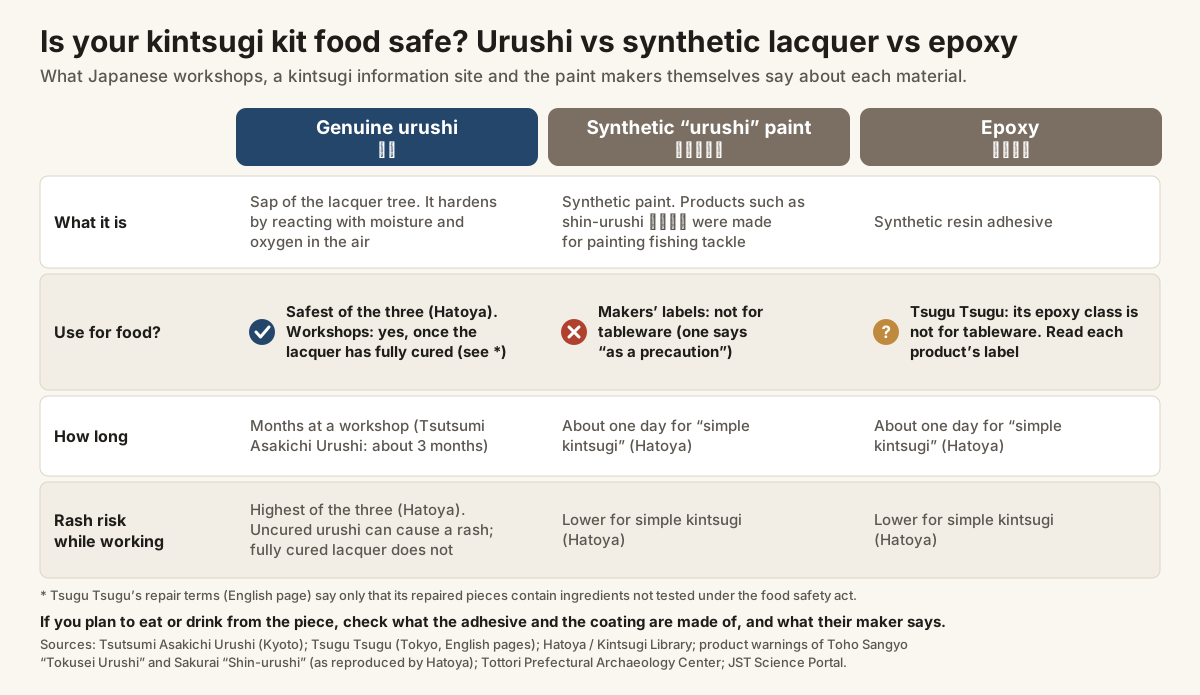
Treat a simple-class piece as decoration, not tableware, until the school says in writing that it is safe for food. Separately, a manufacturer’s warning about lacquer-like coatings concerns products of that kind, not any particular school’s materials; our kit guide sets out those warnings.
How to read a booking-site listing
We could not open the large booking platforms’ listing pages or match them to an operator’s Japanese page, so we recommend none. That is a limit of our checking, not a verdict on those classes. Five questions tell you most of what you need.
Start with who runs the class, and check that the operator’s own Japanese page says the same as the listing.
| Ask | Why it matters | A good answer |
|---|---|---|
| Is it genuine urushi (hon-urushi, 本漆)? | “Lacquer” can mean a synthetic coating | “Natural urushi” |
| What are the glue and the powder? | Gold, tin and brass differ in price and wear | Named materials |
| Which steps do you do? | Finishing only, or glue to finish | A list with times |
| When do you take it home? | A same-day piece is not yet cured | A drying time, and whether it is ready for food |
| Can you bring your own bowl? | Some schools supply every piece | A plain yes or no |
Taking it home
Tsugu Tsugu asks you to dry the piece in a warm room (20 to 30 degrees) for one day to one week. Uzumako asks for about a week at home before use. Raw lacquer can cause a rash if it touches skin before it hardens, as Tsugu Tsugu’s page explains; fully hardened lacquer does not. Our kit guide covers the rash and the wait. For food, see the short answer above.
Where we did not find a class
On the official pages we looked at in November 2026, the lacquer towns of Wajima (輪島) and Kanazawa (金沢) offer chinkin (沈金, incised gold) and makie (蒔絵, sprinkled-gold decoration) experiences, which are different crafts, and we saw no kintsugi experience. Check with each facility before you go. At Tsutsumi Asakichi Urushi in Kyoto, the factory tour has no kintsugi, and its urushi school (うるしの学校), which teaches it, is for members.
One check before you pay
Open the school’s own page and look for a list of what you will do. If there is none, ask before you book.
Sources
- https://kintsugi-girl.com/workshop/
- https://kintsugi-girl.com/kyoto-studio-opening/
- https://kintsugi-girl.com/tsugutsugu/kintsugi-school/
- https://www.uzumakotougei.com/kintsugi_taiken/kintsugitaiken_1
- https://kurumi-kulukulu.com/workshop
- https://kyoto-kurumi.com/
- https://kyoto-kurumi.com/?page_id=754
- https://kyoto-kurumi.com/?page_id=390
- https://www.tsutsumi-urushi.com/kintsugi
- https://www.tsutsumi-urushi.com/experiences/factorytour/
- https://www.tsutsumi-urushi.com/experiences/urushischool/
- https://scienceportal.jst.go.jp/stories/20231115_w01/