Lacquerware Regions Compared: Wajima, Yamanaka, Aizu, Echizen, Kishu
Takumi Path is reader-supported. Some links on this page are affiliate links: if you buy or book through them, we may earn a commission at no extra cost to you. Learn more.
Key points
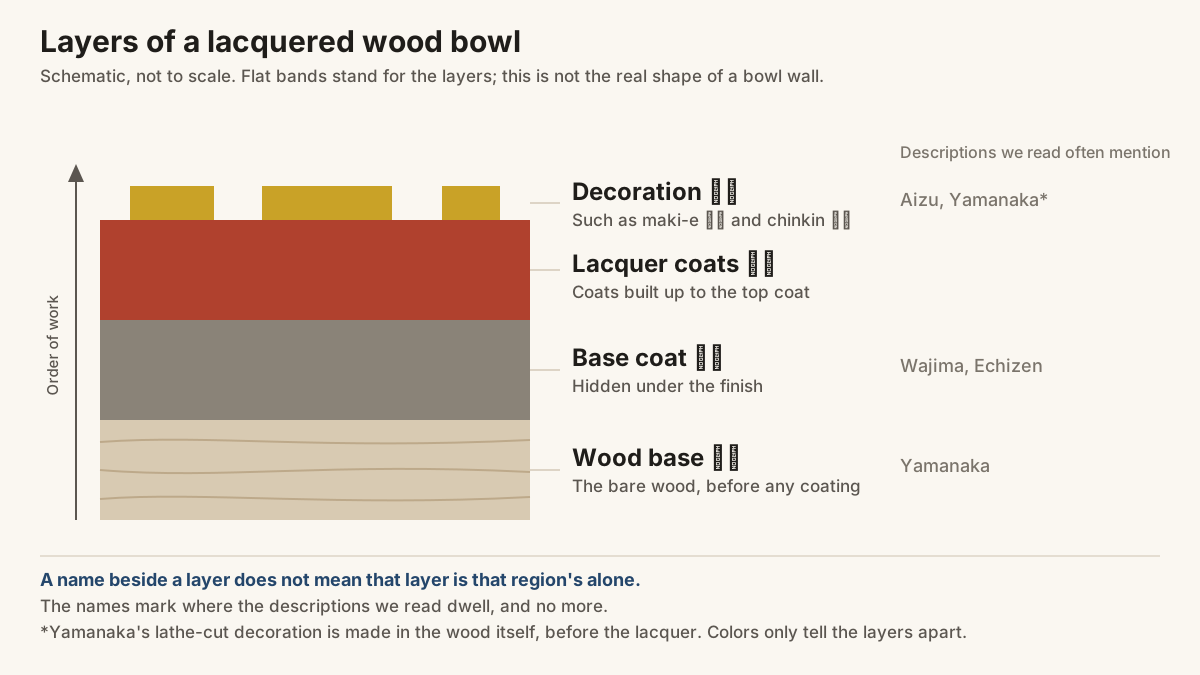
- Ishikawa's heritage pages on Wajima lacquerware and Yamanaka woodturning dwell on very different things: a base coat you never see, and lines cut on the lathe.
- The descriptions we read put their weight in different places. That is emphasis, not a limit on who does what.
- Kishu began with bowls, and Echizen has a designated craft with a commercial resin trade alongside it.
- Take the region's name as a place to start asking, and ask the seller about coating and base.
Contents
- Where each region invites you to start looking
- What to ask a seller
- Yamanaka (山中): lines cut by the lathe
- Wajima (輪島): a base coat you never see
- Aizu (会津): a surface painted by hand
- Kishu (紀州): a region that began with bowls
- Echizen (越前): a designated craft, and a resin trade alongside it
- What a region’s name tells you
Open the Ishikawa Prefecture (石川県) heritage page on Wajima (輪島) lacquerware and it dwells on something you cannot see from the surface: a powder, made from diatomaceous earth found at 小峰山 in Wajima, worked into the base coat under the finish.
Open the prefecture’s heritage page on Yamanaka (山中) woodturning, in another part of Ishikawa, and it dwells on the opposite: the lines that a turner cuts into the wood on a lathe, in 19 kinds of pattern or more, with tools the turners make themselves.
Two pages, two different places to look. The same turns out to hold across the regions we read: each description puts its weight on a different part of the bowl or its making. Knowing where tells you where to start looking at a bowl, and what to ask about it.
Where each region invites you to start looking
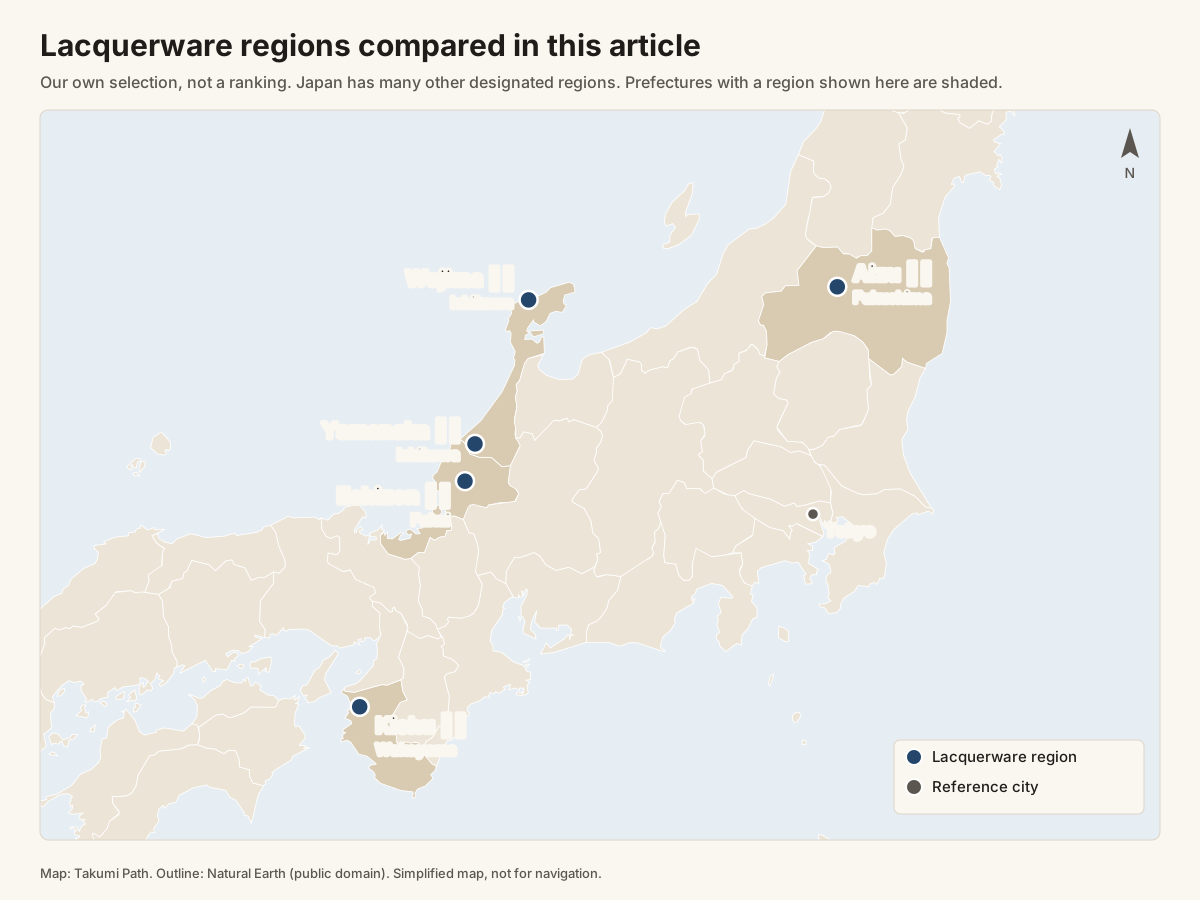
Japan has many nationally designated lacquerware regions. Sabae City (鯖江市) calls Echizen one of Japan’s “five major” lacquerware regions without naming the other four, so the five here are our own choice, and they are not ranked.
| Region | Japanese | Prefecture | National designation | A place to start looking |
|---|---|---|---|---|
| Yamanaka | 山中 | Ishikawa | 1975 | Turned wood, and decoration cut on the lathe |
| Wajima | 輪島 | Ishikawa | 1975 | The base coat under the finish |
| Aizu | 会津 | Fukushima (福島) | 1975 | The hand-painted surface |
| Kishu | 紀州 | Wakayama (和歌山) | 1978 | A region that began with bowls |
| Echizen | 越前 | Fukui (福井) | 1975 | A designated craft, and a commercial resin trade alongside it |
What to ask a seller
When you shop, the person to ask is the seller. Workshops and cooperatives are not necessarily set up to answer questions from abroad.
| If the listing names | You might ask the seller |
|---|---|
| Yamanaka | What is the wood, and how is it cut? Is the pattern cut on the lathe or painted? |
| Wajima | What is the base coat made of, and how is it built up? |
| Aizu | Is the picture hand-painted maki-e? What is it painted with? |
| Kishu | What is the base, and what does the maker say about washing? |
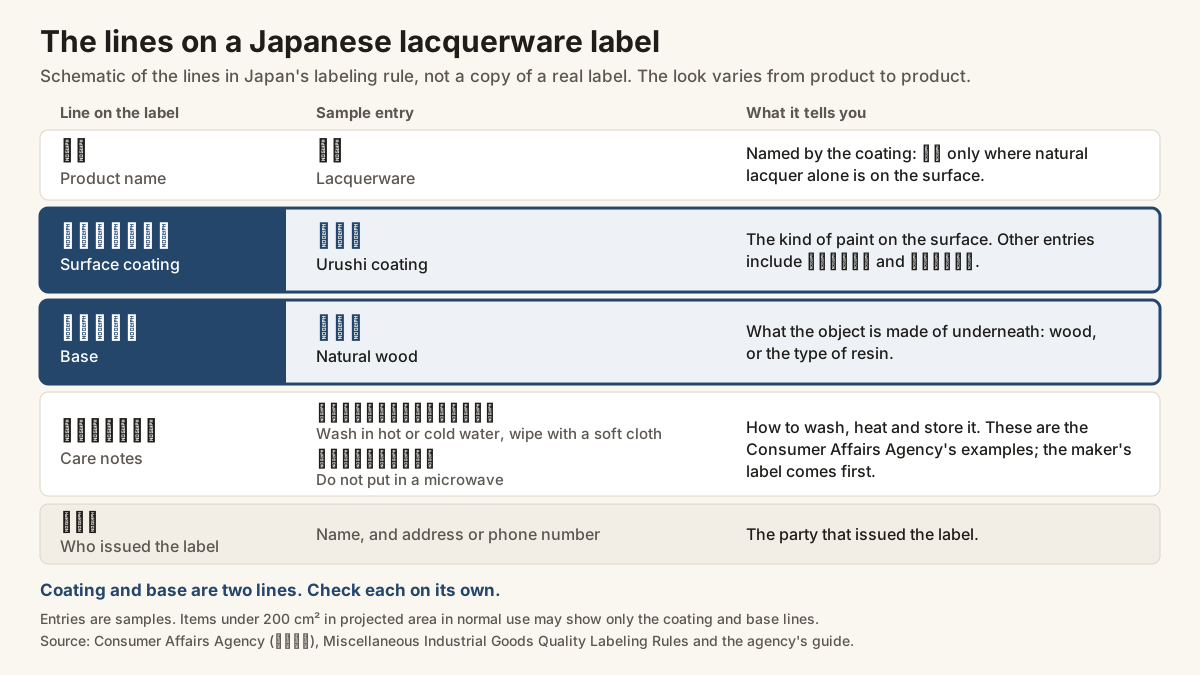
| Echizen | Is the coating urushi or another paint, and is the base wood or resin? |
Yamanaka (山中): lines cut by the lathe
Yamanaka lacquerware comes from the Yamanaka Onsen (山中温泉) district of Kaga (加賀) City. The city calls it the place of the wood base (木地), with Japan’s largest output of turned wood bases, and the prefecture says the district leads Japan’s turning regions in the scale and quality of its craftspeople and in output. A reference book traces the start to turners said to have moved from Echizen in the Tensho era (天正, 1573-92).
The prefecture lists the work from rough turning through finishing to decorative turning, then wiping with lacquer. There are 19 kinds of decorative pattern or more, among them a fine thread-like line pattern (糸目筋). Each pattern needs its own lathe tool, and the turners make the decorating tools themselves. A children’s page from the prefecture describes the result: thin lines cut on the lathe, lacquer soaked in so that the grain stands out. Here the decoration is made by the lathe, not by a brush. The same page also mentions tea utensils decorated with maki-e (蒔絵), designs drawn in lacquer and sprinkled with gold or silver powder.
On the wood itself, Kaga City describes cutting with the direction the tree grew, which keeps the wood from warping as it dries, while the prefecture says lengthwise and crosswise cutting are both used, depending on the piece.
Wajima (輪島): a base coat you never see
Wajima’s base lacquer is mixed with Wajima jinoko (輪島地の粉), a local diatomaceous earth that is fired and ground to powder, the cooperative says. The prefecture names the source and calls the result careful honkataji (本堅地) work; a dictionary defines honkataji as a sturdy base built with cloth and lacquer. The powder goes on in three rounds, from coarser grains to finer, the cooperative says. The children’s page adds the rhythm: lacquer is applied and ground back, again and again.
A base is not all there is to a Wajima bowl. Dictionaries name decoration by chinkin (沈金), carving a pattern into the lacquer and pressing gold into the grooves, as especially active in Wajima, and Echizen’s city page says chinkin from Wajima reached Echizen at the end of the Edo period (江戸時代).
The cooperative also says Wajima’s work is divided into wood, lacquering and decoration, with a nushiya (塗師屋) acting as a producer-like coordinator who checks and adjusts the work.
Two and a half years after the January 2024 Noto Peninsula earthquake (能登半島地震), production capacity was back to about 60 to 70 percent of its pre-quake level, an official of the cooperative said in a report distributed by Kyodo News (共同通信) in July 2026. The same report notes that Wajima-nuri must be made inside the city to be designated, so work cannot simply be made elsewhere under the name.
Aizu (会津): a surface painted by hand
The Japan Tourism Agency (観光庁), in its guide in several languages, describes Aizu lacquerware as built of many layers of lacquer, sorted into round pieces such as bowls and flat pieces such as trays and boxes. The decoration is painted by hand in colored lacquer with gold and silver powder, in intricate designs; typical ones include pine, plum, bamboo and auspicious arrows (破魔矢). Aizu was designated in 1975.
Dictionaries trace Aizu’s beginnings to the Tensho era and to the lord Gamo Ujisato (蒲生氏郷), who brought in woodworkers and lacquerers.
Kishu (紀州): a region that began with bowls
Kainan City (海南市) in Wakayama says the craft’s origins may go back to the Muromachi period (室町時代), and that by the early Edo period Kishu was known as a region centered on shibuji bowls (渋地椀). A dictionary defines shibuji as persimmon tannin (柿渋) applied to the wood, with lacquer over it. Wakayama Prefecture’s magazine says the craft “has always stayed close to people’s lives and grown with them”, and another issue says that from the Edo period ordinary people used it every day.
The prefecture adds that in the Edo period flat-board ware (板物) on a honkataji base arrived, and maki-e was added. It says the region introduced a division of labor among wood, lacquering and decoration, and developed on that basis. Kainan City gives the size: 112 companies as of March 2020, and about 5.9 billion yen in annual shipments, with no year stated for that figure. A prefectural magazine also says Negoro-nuri (根来塗), the lacquerware monks used at Negoro Temple (根来寺), “is said to have had a great influence” on Kishu ware.
Echizen (越前): a designated craft, and a resin trade alongside it
Echizen lacquerware was designated in 1975, and Sabae City records its methods. The wood base is either turned on a lathe from wood cut along the direction the tree grew, or shaped from boards. There are two kinds of base coat: one with persimmon tannin and pine soot (松煙), and one that uses jinoko mixed with raw lacquer and rice paste. The same word appears in Wajima’s pages; whether it is the same earth we cannot tell from what we read. The top coat uses refined lacquer, by one of two named methods (花塗 or ろいろ塗), and decoration is by chinkin or maki-e. The city describes the whole region as a division of labor in which base-making, coating and decoration are highly specialized.
Those are the methods the city’s page lists for the designated craft. Resin ware is described separately, as a commercial trade alongside it. Sabae City says most lacquerware used in food service is resin, much of it from Echizen, and that tableware safe for a dishwasher or microwave has been developed there. Alongside traditional wooden ware, it says, the region now offers cheaper, sturdier products using synthetic resin or chemical paints, which has made lacquerware easier for anyone to buy and more familiar. The city puts Echizen’s share of Japan’s commercial-use lacquerware at about 80 percent.
What a region’s name tells you
Wajima’s cooperative, Wakayama Prefecture and Sabae City each describe the work as divided among wood, lacquering and decoration, so a bowl from these regions typically passes through several specialized hands. A designated name is tied to a place and a method, and that is worth knowing.
Wajima’s pages talk about a base you cannot see, and Yamanaka’s about lines you can; either is a way in to the questions above. What the bowl in front of you is coated with and made of is for the two label lines to say, and our label guide shows how to read them.
Sources
- https://www.pref.ishikawa.lg.jp/kyoiku/bunkazai/mukei/1.html
- https://wajimanuri.or.jp/kaikan/wajimanuri/
- https://www.pref.ishikawa.lg.jp/kyoiku/bunkazai/mukei/k5.html
- https://www.pref.ishikawa.lg.jp/kensei/koho/kids/kodomo/dentou/main.html
- https://www.city.kaga.ishikawa.jp/ijyu/5/7236.html
- https://www.mlit.go.jp/tagengo-db/R4-00503.html
- https://www.city.kainan.lg.jp/kanko/tokusanhin/kishushikki.html
- https://www.pref.wakayama.lg.jp/prefg/000200/nagomi/w57/10/index.html
- https://www.pref.wakayama.lg.jp/prefg/000200/nagomi/w55/08_09/index.html
- https://www.pref.wakayama.lg.jp/bcms/prefg/000200/kenmin/web/202002/taiken.html
- https://www.city.sabae.fukui.jp/kosodate_kyoiku/manabenoyakata/bunkazai/sabae_bunkazai/mukeibunkazai/90-city.html
- https://www.city.sabae.fukui.jp/users/sabae_biyori/html/echizen.html
- https://info.pref.fukui.lg.jp/tisan/monosato/shikki.html
- https://www.sakigake.jp/news/article/20260702CO0134/
- https://kotobank.jp/word/%E8%92%94%E7%B5%B5
- https://kotobank.jp/word/%E6%9C%AC%E5%A0%85%E5%9C%B0
- https://kotobank.jp/word/%E6%B2%88%E9%87%91
- https://kotobank.jp/word/%E4%BC%9A%E6%B4%A5%E5%A1%97
- https://kotobank.jp/word/%E8%BC%AA%E5%B3%B6%E5%A1%97-154056
- https://kotobank.jp/word/%E5%B1%B1%E4%B8%AD%E6%BC%86%E5%99%A8
- https://kotobank.jp/word/%E6%B8%8B%E5%9C%B0
- https://kotobank.jp/word/%E6%A0%B9%E6%9D%A5%E5%A1%97