How to Read a Japanese Lacquerware Label: Coating and Base
Takumi Path is reader-supported. Some links on this page are affiliate links: if you buy or book through them, we may earn a commission at no extra cost to you. Learn more.
Key points
- Japan's labeling rule for lacquered tableware names a product by its surface coating; the base material is a separate line.
- Resin lacquerware is a real trade: Sabae City says Echizen accounts for about 80 percent of Japan's production of commercial resin lacquerware.
- A place name in a listing points to a style or a region; the coating and base lines say what the bowl is made of.
- Natural lacquer is slow work: the Agency for Cultural Affairs holds a 32-piece process sample set for a Wajima-nuri bowl.
- The Consumer Affairs Agency's care notes are examples; the maker's own label comes first.
Contents
An English product page calls a bowl “lacquer”. Is that real urushi (漆), the sap of the lacquer tree, or a paint that looks like it? Can the bowl go in the dishwasher? The page may not say, and “lacquer”, “urushi-style” and “Japanese lacquerware” can each mean something different.
Japan has a way to answer. For tableware, the labeling rule treats two facts separately: what the surface is coated with, and what the bowl is made of underneath. Read those two lines and you can ask the seller better questions. None of this is about “real or fake”. A resin bowl made for commercial use is not a fake of anything; it is a trade of its own, as we will see below.
What an English product page can and cannot tell you
Words such as “lacquer”, “urushi-style” or urushi-nuri (漆塗り, “lacquer-coated”) are not among the terms listed in the Japanese rule. We have not found how the rule treats them, so take each as a prompt to ask, not as an answer. Four questions cover most of it:
- What is the surface coating? Urushi, cashew resin paint, urethane, or something else?
- What is the base? Wood (which species?) or resin?
- What does the maker say about washing and heating? The Consumer Affairs Agency (消費者庁) gives examples of care notes: wash in hot or cold water and wipe with a soft cloth, keep out of direct sunlight, do not put in a microwave or dishwasher. They are examples. Check each product’s own label, because the maker’s instructions come first.
- Who made it, and where? The coating and base lines do not say; look for the maker’s name and a place of manufacture.
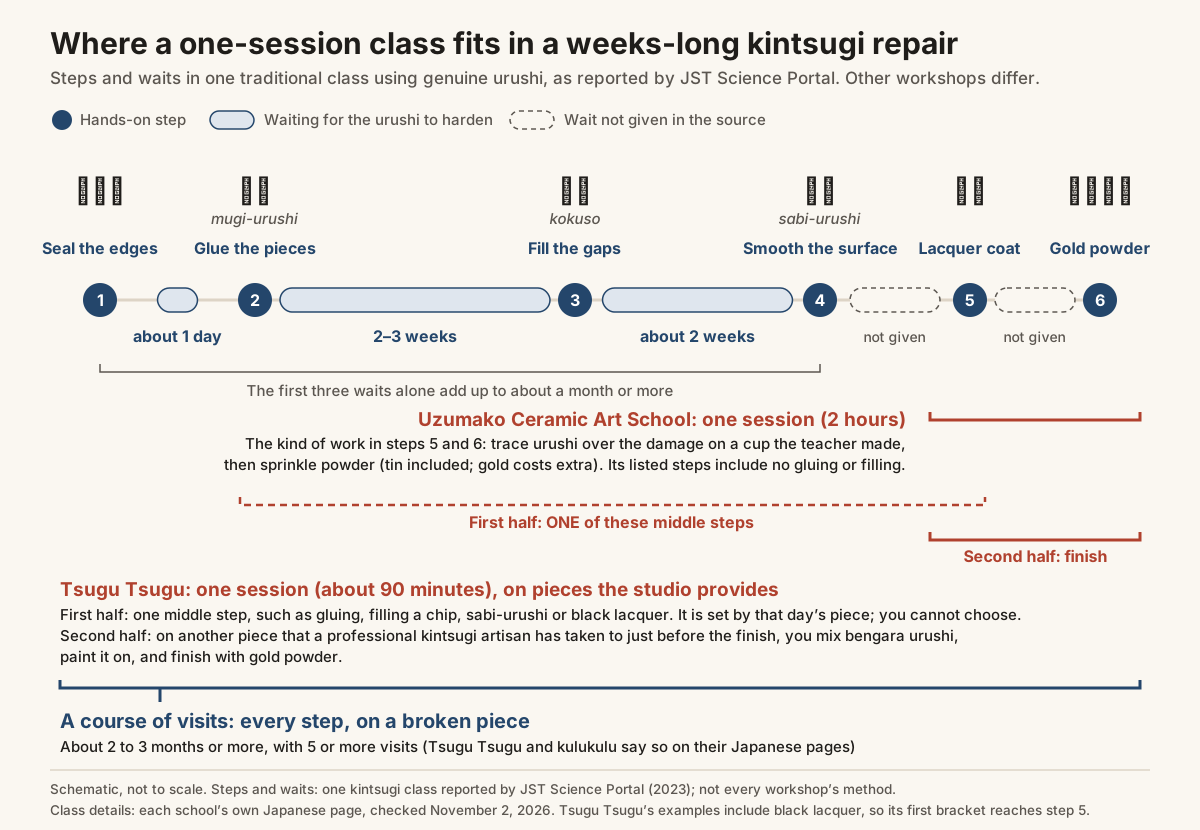
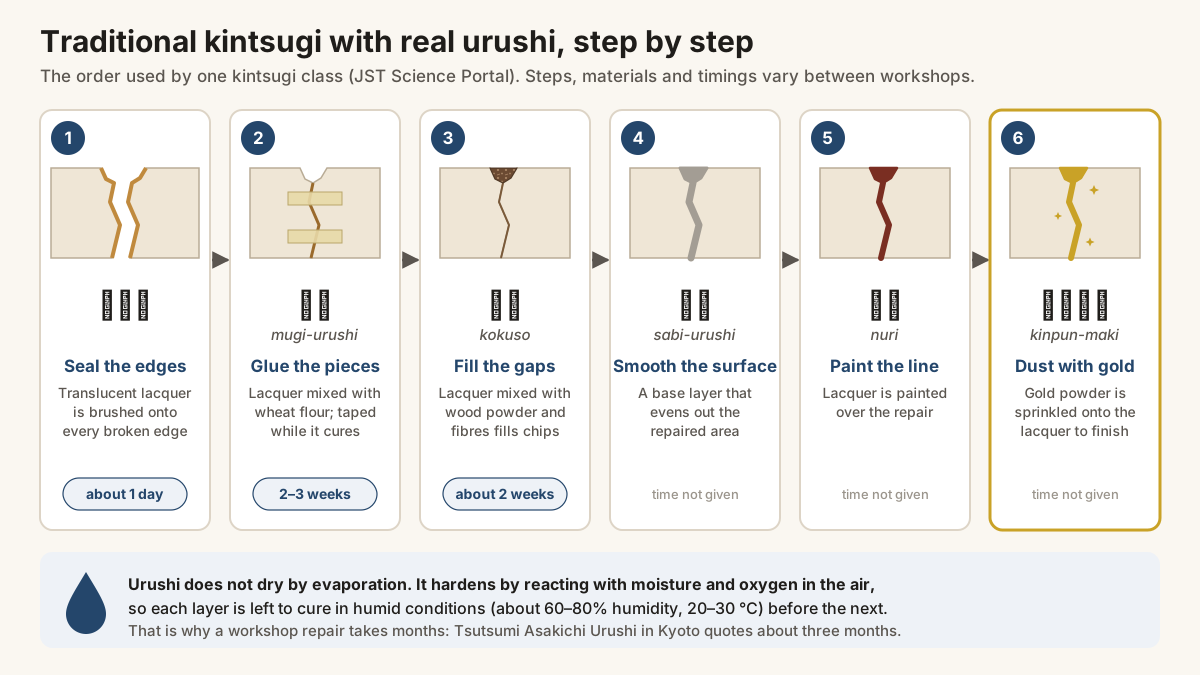
Do not count on looks or touch; we have found no source that says a buyer can tell coatings apart by eye. Urushi hardens by reacting with air over a long time, and unhardened lacquer can cause a rash. Our guide to how kintsugi works and the kintsugi kit article cover both.
The Japanese label: four lines and a name
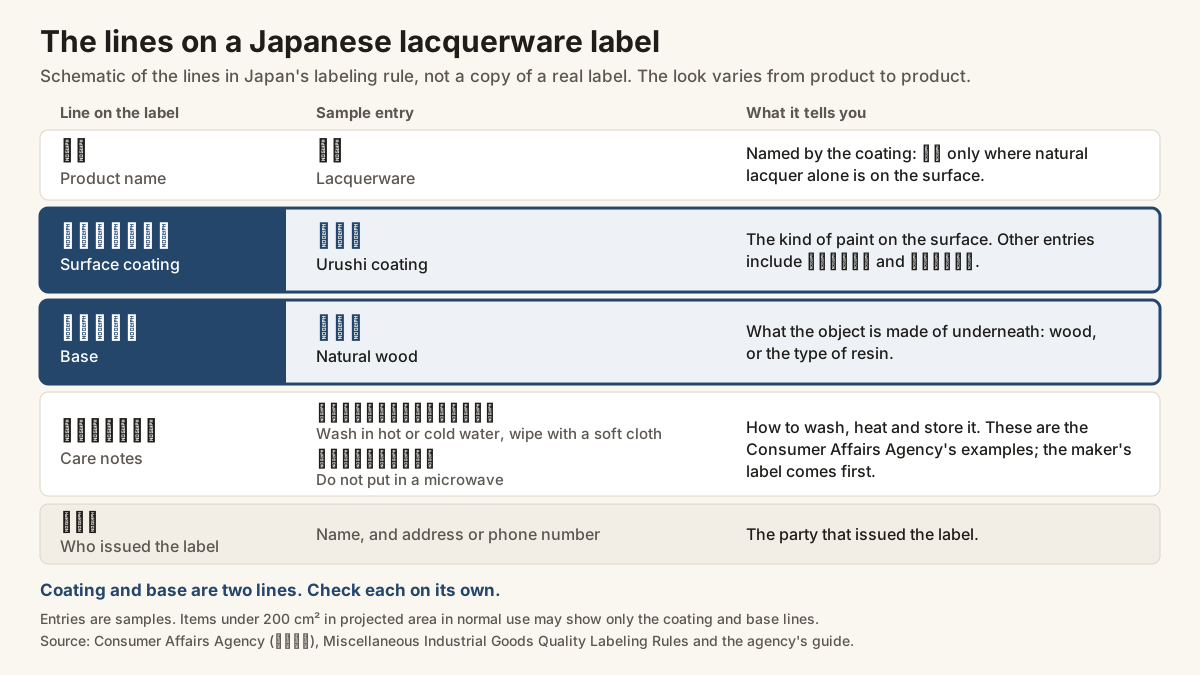
The rule is part of the Household Goods Quality Labeling Act (家庭用品品質表示法). The Consumer Affairs Agency publishes it as an item of the Miscellaneous Industrial Goods Quality Labeling Rules (雑貨工業品品質表示規程), for meal, table and kitchen utensils coated with lacquer or cashew resin paint and similar, in wood or resin.
| Line | Japanese term | What it tells you |
|---|---|---|
| Product name | 品名 | Whether the name may be “lacquerware” |
| Surface coating | 表面塗装の種類 | The kind of paint on the surface |
| Base | 素地の種類 | What the object is made of underneath |
| Care notes | 取扱い上の注意 | How to wash, heat and store it |
The naming rule looks at the coating. Where only natural lacquer is used on the surface, the name shikki (漆器) is to be used; where other paints are used, the product is to carry a term that says what it is, such as “synthetic lacquerware” (合成漆器). The coating line then names the paint:
| Label says | Japanese | Plain English |
|---|---|---|
| Urushi coating | 漆塗装 | Natural lacquer, the tree sap |
| Cashew coating | カシュー塗装 | Cashew resin paint, not urushi |
| Melamine-alkyd coating | メラミンアルキド塗装 | A synthetic paint |
| Urea-alkyd coating | ユリアアルキド塗装 | A synthetic paint |
| Urethane coating | ウレタン塗装 | A synthetic paint |
The base line names the main material: “natural wood” (天然木), with the species optionally added, or the type of resin. The label also carries the name of whoever issued it, with an address or phone number.
Resin ware is a trade; natural lacquer is slow work
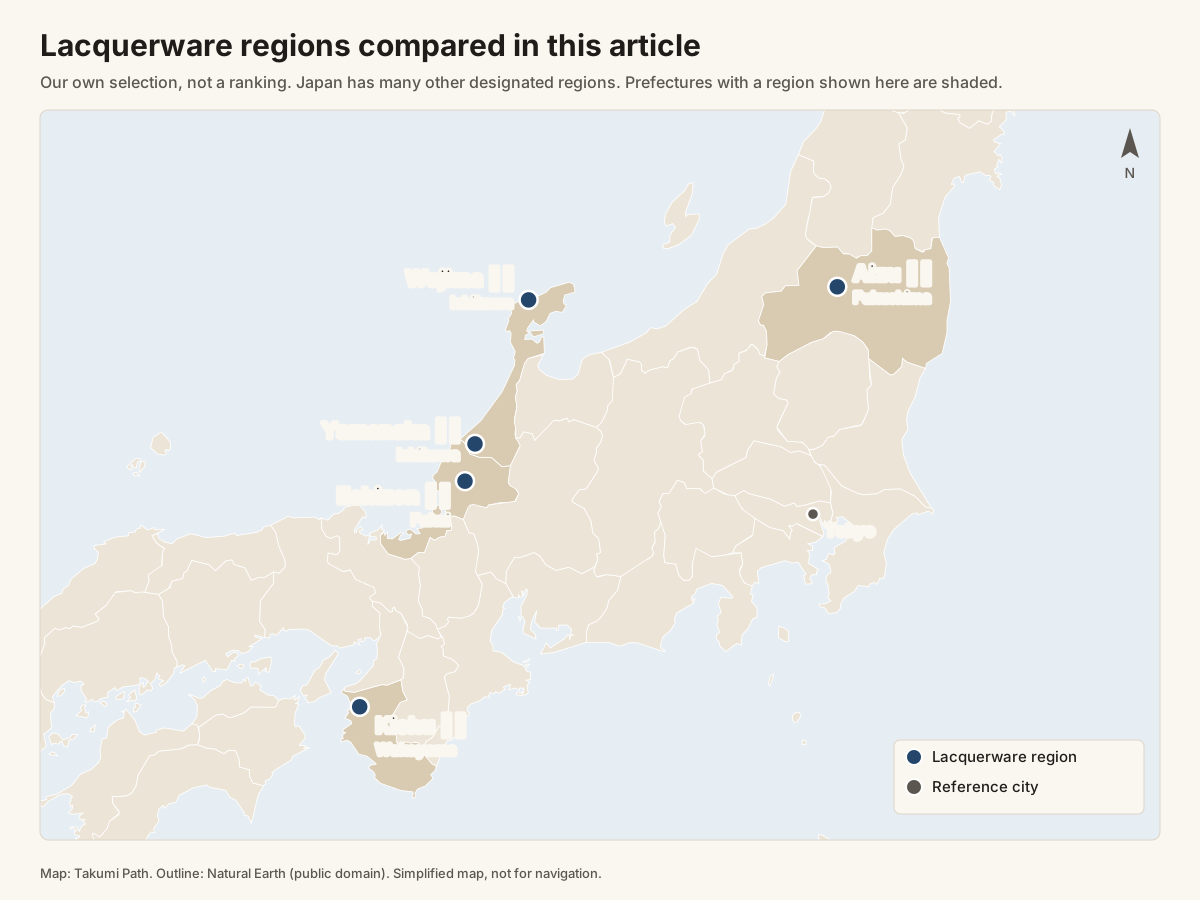
Sabae City (鯖江市) in Fukui calls the home of Echizen lacquerware (越前漆器) one of Japan’s five main lacquerware regions, and says it accounts for about 80 percent of national production of commercial-use resin lacquerware. Resin ware that says it is resin is simply telling you what it is. The same city page also records the methods of the region’s designated craft: wood bases, with turned pieces shaped on a lathe, finishing with refined lacquer, and decoration by chinkin (沈金) or maki-e (蒔絵). Two kinds of work sit under one regional name.
Natural lacquer asks for time. The Agency for Cultural Affairs (文化庁) holds a process sample set for a Wajima-nuri (輪島塗) simmered-dish bowl, made in 2000: 32 pieces, two of raw materials and 30 samples of the stages from the bowl’s wooden base through base layers, lacquer coats and polishing to decoration. Part of the price of an urushi bowl is that time; that is our reading, not a figure from a source. A line that says “urushi coating” cannot tell you how hand-made the work was. And good urushi work is not limited to designated regions: independent artists and workshops outside the designated crafts work in natural lacquer too.
A place name, and a stamp
For a nationally designated craft, a place name is tied to the place and the method. Wajima-nuri must be made inside the city to be designated, Kyodo News reported in July 2026, and Echizen lacquerware was registered as a regional collective trademark (地域団体商標) in 2007, held by the Echizen lacquerware cooperative (越前漆器協同組合).
A place name in a listing can also simply say where a style comes from. One Japanese online shop listing we read named a bowl after a lacquerware region and called it “lacquer-style” (漆器風), with PET and ABS resin in the materials field. The listing was open about it; we do not know whether the item counts as a designated craft. Either way, the name tells you about style or origin, and the coating and base lines tell you the material.
A stamp helps too. Niigata Prefecture (新潟県) explains that crafts bearing a certificate stamp (伝統証紙) with the Traditional Mark (伝統マーク) have passed an inspection run by the producing region’s association or a similar body, and are designated by the Minister of Economy, Trade and Industry (translation ours). A stamp is a strong sign. A missing stamp is no sign at all; we have not found a source saying every designated piece carries one.
Where the lacquer comes from
The label lines do not say where the sap was grown, and we found no source tying a famous lacquerware name to domestic lacquer. Japan’s Ministry of Agriculture, Forestry and Fisheries (農林水産省) wrote in 2022 that most of the lacquer used to make lacquerware is imported, from China and elsewhere, while since fiscal 2018 the Agency for Cultural Affairs’ policy has been to use domestic lacquer, in principle, for repairs of national treasure and important cultural property buildings. The Forestry Agency (林野庁) reports domestic production of 1,885 kg in 2025 (Reiwa 7), and says 93 percent of domestic consumption is imported, mostly from China.
Imported lacquer is the ordinary material of the trade, and domestic lacquer is the scarcer one. The figures change from year to year, so quote the year. If origin matters to you, ask the seller.
What a good listing sounds like
The best listing is not the one that says “lacquer” most often. It is the one that tells you in plain words what the surface is and what lies underneath, whether the bowl is resin or urushi on wood.
Sources
- https://www.caa.go.jp/policies/policy/representation/household_goods/law/law_07/item_012.html
- https://www.caa.go.jp/policies/policy/representation/household_goods/guide/zakka/zakka_19.html
- https://www.city.sabae.fukui.jp/kosodate_kyoiku/manabenoyakata/bunkazai/sabae_bunkazai/mukeibunkazai/90-city.html
- https://www.city.sabae.fukui.jp/users/sabae_biyori/html/echizen.html
- https://info.pref.fukui.lg.jp/tisan/monosato/shikki.html
- https://online.bunka.go.jp/db/heritages/detail/174511
- https://www.sakigake.jp/news/article/20260702CO0134/
- https://ryukyushimpo.jp/kyodo/entry-5360327.html
- https://kotobank.jp/word/%E8%B6%8A%E5%89%8D%E6%BC%86%E5%99%A8
- https://www.pref.niigata.lg.jp/sec/shogyoshinko/1356804108095.html
- https://www.rinya.maff.go.jp/j/tokuyou/tokusan/index.html
- https://www.maff.go.jp/j/pr/aff/2211/spe1_02.html