How Wajima-nuri Is Made: The Hands a Lacquer Bowl Passes Through
Takumi Path is reader-supported. Some links on this page are affiliate links: if you buy or book through them, we may earn a commission at no extra cost to you. Learn more.
Key points
- In the Agency for Cultural Affairs' process sample for a Wajima-nuri bowl, 16 of the 30 samples are wood base and ground, stages the finished bowl does not show.
- The Agency lists eight trades in three departments, and a nushiya checks and adjusts the whole.
- The base uses a local diatomite powder in three passes from coarse to fine, each dried and ground; the cooperative calls it a stage where nothing can be fudged.
- Published step counts (thirty for lacquering alone, 124, over 100) cover different ranges.
- The 1977 and 1975 national designations are different systems; as of July 2026, production was about 60 to 70 percent of its pre-quake level.
Contents
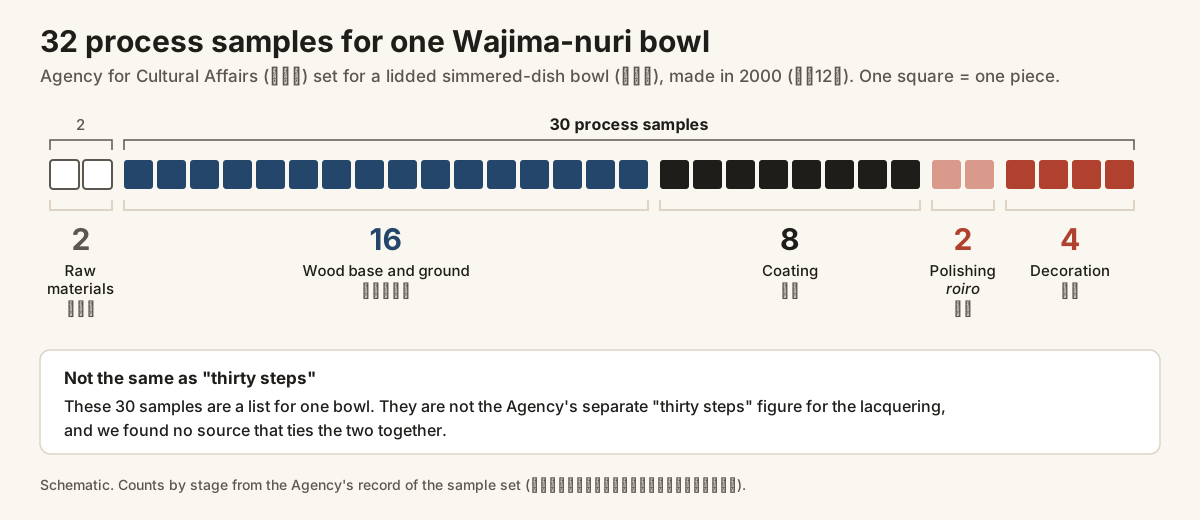
The Agency for Cultural Affairs (文化庁) holds a set of process samples for a Wajima-nuri (輪島塗) bowl: 30 samples, each showing one named stage of the work. Count them and 16 are wood base and ground, more than half. They are the stages a finished bowl does not show.
The cooperative of Wajima’s lacquerware makers (輪島漆器商工業協同組合) calls the ground work “an important stage where nothing can be fudged” (translation ours). The work is divided among specialist trades, and this article follows one bowl through them, using the cooperative’s account and the Agency’s records.
Eight trades, one bowl
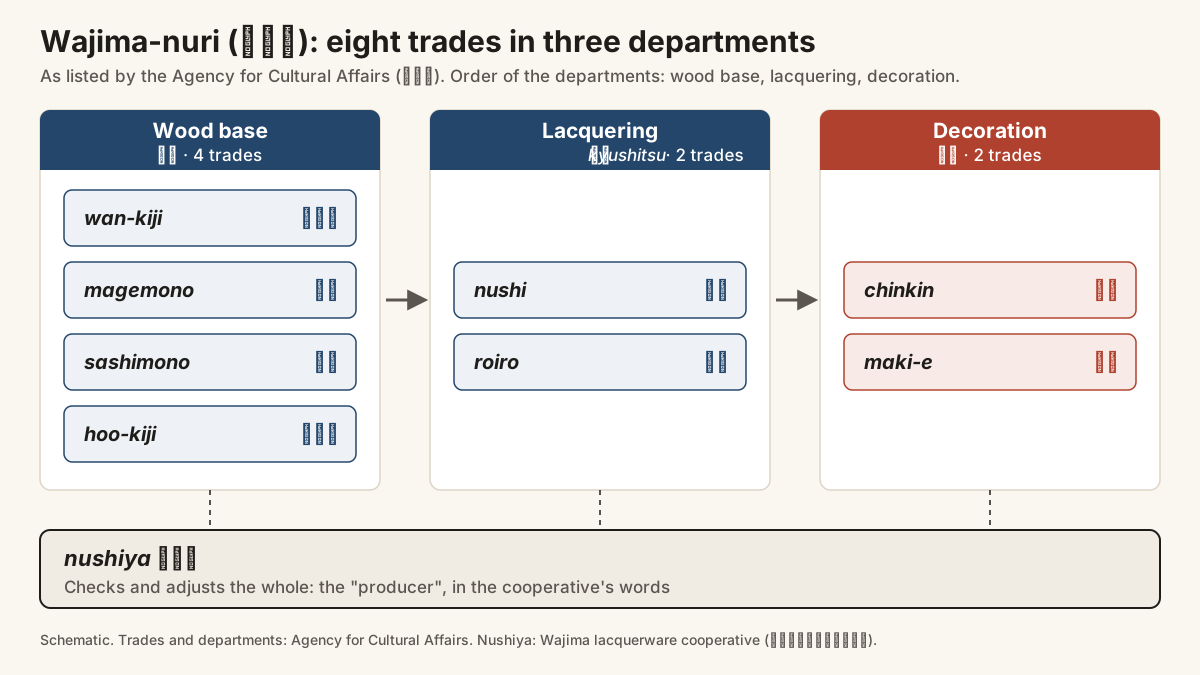
The Agency lists eight trades in three departments. In the Edo period (江戸時代) there were six, it says.
| Department | Trade | Japanese | In short |
|---|---|---|---|
| Wood base | wan-kiji | 椀木地 | Turns round vessels such as bowls and plates on a lathe, with turning tools, kanna (カンナ), held against the spinning wood |
| Wood base | magemono | 曲物 | Soaks thin straight-grained boards until soft, then bends them into round trays and lunch boxes |
| Wood base | sashimono | 指物 | Joined work, such as stacked boxes and square trays |
| Wood base | hoo-kiji | 朴木地 | Carved shapes with many curves, such as legs for low tables and flower stands, and spoons |
| Lacquering (髹漆, kyushitsu) | nushi | 塗師 | The lacquerer; a dictionary defines the word as a craftsperson who does lacquer coating |
| Lacquering | roiro | 蠟色 | Polishing, below |
| Decoration | chinkin | 沈金 | Chiseled patterns filled with gold |
| Decoration | maki-e | 蒔絵 | Patterns drawn in lacquer and dusted with gold or silver powder |
The other descriptions are the cooperative’s. The sources we read do not say which of these trades does the cloth and the ground work, so we do not assign them.
A dictionary explains how six became eight. The six were the turned, joined and bent wood-base trades, the lacquerer, chinkin and maki-e, and in the middle of the Meiji period (明治) hoo-kiji split from joinery and roiro from lacquering. Someone has to hold the trades together, and the cooperative calls that person the nushiya (塗師屋): the “producer” who checks every stage and adjusts it.
The roots are old. The Agency notes that a ridge-beam tablet (棟札) of 1476 in a shrine hall in Wajima (重蔵権現講堂) lists the names of lacquerers.
The part you never see: cloth and powder
Once the wood base is made, the cooperative says, cloth is glued with lacquer onto the parts of the wood that are easily damaged. This is nunokise (布着せ), the cloth step. A dictionary adds that the upper rim and the foot ring (高台) are reinforced this way.
Then comes the base work, jitsuke (地付け). Into the base lacquer goes jinoko (地の粉): the cooperative’s “Wajima jinoko” (輪島地の粉) is local diatomaceous earth, fired and ground to a powder. Ishikawa Prefecture names a source, 小峰山 in Wajima. The cooperative gives the reason: diatomite insulates well, and bonded with lacquer it makes a film that is very hard and durable.
The powder goes on in three passes, from coarse grains to fine. The cooperative names them with kanji meaning first, second and third pass of the ground (一辺地, 二辺地, 三辺地). After each pass the bowl is dried slowly and ground back before the next. This is what the cooperative says is done “to finish a vessel of real quality”.
The prefecture calls Wajima’s base work careful honkataji (本堅地), a term a dictionary defines as a sturdy base built with cloth and lacquer. One dictionary dates the turning point for today’s technique to the Kanbun era (寛文, 1661-73), when jinoko was found.
The top coat: a brush and no dust
For the top coat, uwanuri (上塗), the cooperative says the craftsperson brushes on fine refined lacquer, and that dust is extremely unwelcome, so the work is done with great care. It ties the skill of the top-coat craftsperson to blending the lacquer so that the best film is obtained every time.
Time runs through all of this. The cooperative says the base is dried slowly after each coat, and a 2024 report in the Hokuriku Chunichi Shimbun (北陸中日新聞) writes that Wajima work needs controlled temperature and humidity and a sealed space that keeps dust out. How urushi hardens is explained in our kintsugi guide.
Polishing, and a soft hand
Next is roiro (呂色). The cooperative says the surface is ground smooth with a special polishing charcoal (研炭), and then lacquer is rubbed in as it is polished; this is repeated. “In the end it is polished by a person’s soft hand,” it says, and the lacquer’s deep, glossy quality comes forward. (The Agency’s table spells the trade 蠟色; both are read roiro.)
Gold in the surface
Decoration comes last. In chinkin, the cooperative says, a pattern is chiseled into the lacquered surface, lacquer is rubbed in, and gold leaf or gold powder is set into the grooves. In maki-e, a brush loaded with lacquer draws the pattern and gold or silver powder is scattered over it to fix it. The Agency’s sample set ends with five finished bowls: one in plain black lacquer, two in maki-e and two in chinkin.
How many steps?
You will read very different step counts for Wajima-nuri, because they cover different ranges. The Agency, describing the technique, says careful work “of thirty steps even for the lacquering alone”. The cooperative’s front page says 124. A Kyodo News (共同通信) report in 2026 says over 100, with the work divided among craftspeople. We do not pick one.
The Agency’s sample set is another list again: a lidded simmered-dish bowl, made in 2000 (平成12年), in 32 pieces, two of raw materials and 30 samples. Beyond the 16 of wood base and ground, 8 are coating, 2 polishing and 4 decoration. It is a list for one bowl from wood to decoration, not the Agency’s “thirty steps” of lacquering.
Two national designations
Wajima-nuri holds two national designations, under different systems. It was designated an Important Intangible Cultural Property (重要無形文化財) on 25 April 1977, according to the Agency and Ishikawa Prefecture. The prefecture names the recognized holder as a group, the Wajima-nuri Technology Preservation Society (輪島塗技術保存会); under the Agency’s general rule, a group is recognized when a skill is held by many people rather than marked by one person’s style. The other is the national traditional craft (伝統的工芸品) designation, now made by the Minister of Economy, Trade and Industry; dictionaries date Wajima-nuri’s to 1975.
Wajima now
The Noto Peninsula earthquake (能登半島地震) struck on 1 January 2024. In a Kyodo report carried by the Akita Sakigake Shimpo (秋田魁新報) on 2 July 2026, an official of the cooperative said production capacity was about 60 to 70 percent of its level before the quake. The official explained that some craftspeople have closed their businesses or have not returned to Wajima. It adds that making Wajima-nuri inside the city is a condition of the traditional craft designation, so work cannot be shifted to another area.
The cooperative’s website, as we read it in November 2026 and without a date, says a temporary cooperative lacquer-refining plant (組合精漆工場) has been completed and has begun operating, and that its Wajima-nuri Kaikan (輪島塗会館) hall is closed temporarily “for the time being”. These facts change, so check the cooperative’s own pages.
Counting the hands
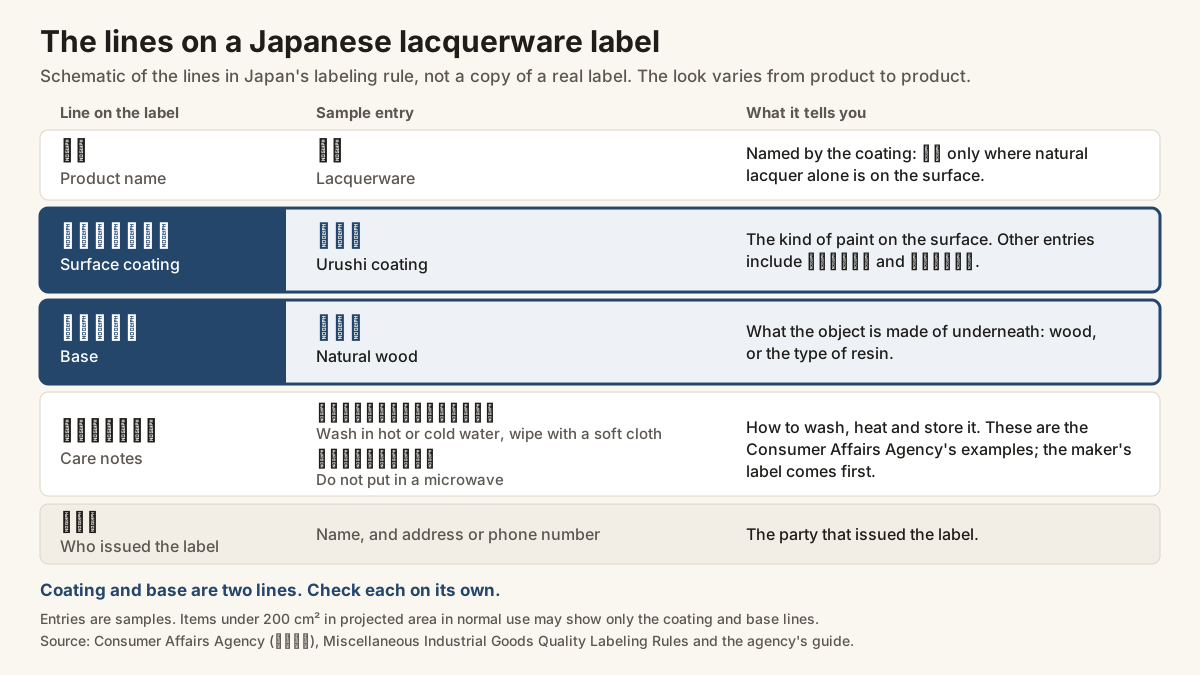
Count the hands again: four wood-base trades, the lacquerer, the polisher, chinkin and maki-e, with a nushiya checking all of it. Behind a finished bowl stand eight trades, and 16 of the 30 samples record work that stays hidden. It is our reading, not a source’s, that this unseen labor helps explain what such a bowl costs. To see how a listing describes the coating and the base, start with our label guide.
Sources
- https://wajimanuri.or.jp/kaikan/wajimanuri/
- https://wajimanuri.or.jp/
- https://www.pref.ishikawa.lg.jp/kyoiku/bunkazai/mukei/1.html
- https://online.bunka.go.jp/heritages/detail/160148
- https://online.bunka.go.jp/db/heritages/detail/174511
- https://www.bunka.go.jp/seisaku/bunkazai/shokai/mukei/
- https://www.sakigake.jp/news/article/20260702CO0134/
- https://www.chunichi.co.jp/article/884533
- https://kotobank.jp/word/%E8%BC%AA%E5%B3%B6%E5%A1%97-154056
- https://kotobank.jp/word/%E6%9C%AC%E5%A0%85%E5%9C%B0
- https://kotobank.jp/word/%E5%A1%97%E5%B8%AB